Offshore Foundations
When are jacket offshore wind foundations preferred to monopiles?
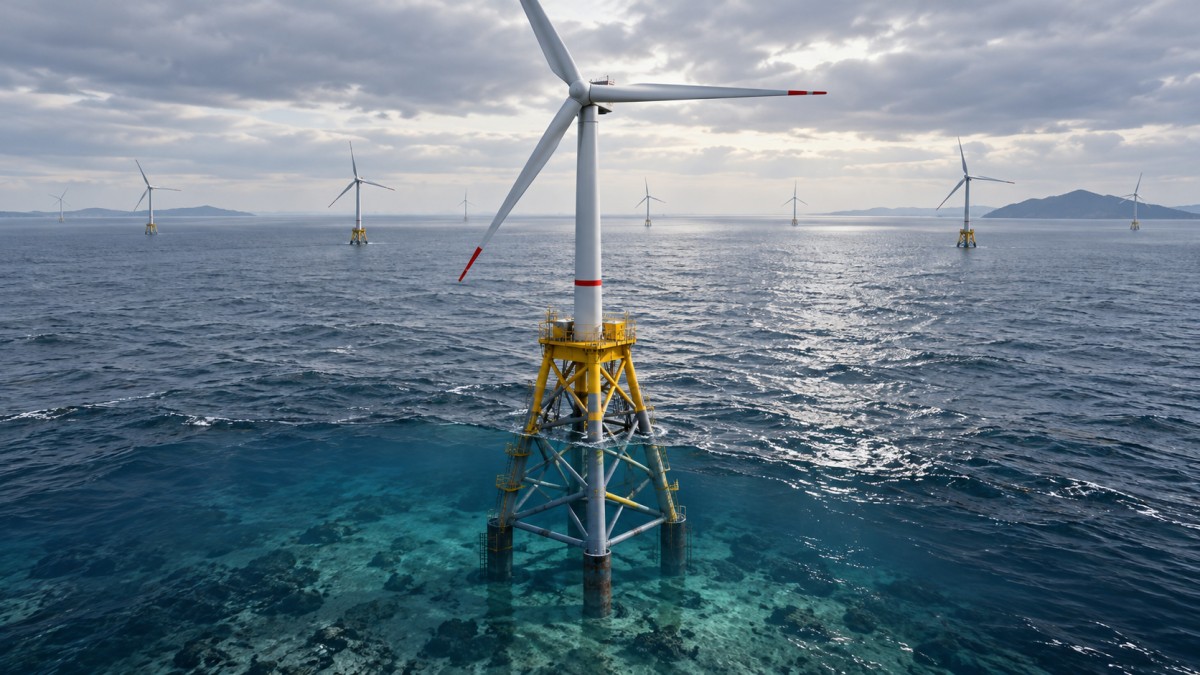
Jacket offshore wind foundations are preferred when a braced structure and several smaller foundation points provide a better overall design and installation outcome than one large monopile. That situation becomes more likely as water depth and overturning loads increase, or when the diameter, wall thickness, driving energy or handling demands of a monopile approach project limits. A jacket is also a candidate where its anchoring arrangement suits the ground and available installation equipment.
Water depth alone does not settle the choice. Large monopiles have extended the range of sites where a single tubular foundation is viable, while jackets bring their own demands: multiple piles or anchors, complex welded joints, larger transport envelopes and more offshore interfaces. The preferred concept is the one that meets structural and installation requirements with the lowest credible project-wide exposure, not simply the lowest estimated steel weight.
Where water depth and loading change the balance
A monopile resists turbine and environmental loads primarily through bending of a large tube and its interaction with the soil. As unsupported length increases, deflection and bending stresses become more demanding. A jacket uses a wider footprint and bracing to distribute loads through its legs and foundation points; much of the load is carried through axial forces in the members. This geometry can make a jacket attractive where a monopile would require a particularly large diameter or thick wall to satisfy strength, fatigue or stiffness requirements.
Depth is only a proxy for these structural demands. A site with severe waves, strong currents or a large turbine overturning moment may reach a monopile design constraint sooner than a deeper but less demanding site. Conversely, a deeper site does not automatically favor a jacket if the seabed provides effective lateral support and the available fabrication and installation equipment can accommodate the monopile.
The governing load case also matters. A concept that has adequate ultimate strength under an extreme storm may still be governed by fatigue from repeated wind and wave loading. Turbine operating states, shutdown events, wave direction, current, marine growth and soil response all affect the result. Comparing foundation concepts using only a turbine rating or a single design wave height leaves too much of the load spectrum unexamined.
Stiffness is a system property, not a foundation label
The foundation, soil, tower and turbine form a dynamic system. Its natural frequencies must be assessed against excitation from rotor rotation, blade passing and waves across relevant operating conditions. A jacket's wide base does not guarantee an acceptable dynamic response: brace dimensions, joint flexibility, pile stiffness and the effective support from the ground all influence the outcome. A monopile's response likewise changes with embedment, diameter, wall thickness and soil behavior.
Early comparisons are particularly sensitive to assumed soil stiffness. A model based on limited ground data can produce an apparently comfortable frequency separation that narrows when cyclic degradation, layered soils or installation effects are represented more realistically. Frequency checks therefore need consistent turbine and soil assumptions across both concepts, with sensitivity cases where the ground response is uncertain.
Stiffness requirements can also change during turbine selection. A larger rotor, a revised tower or a different control strategy alters loading and dynamic behavior. A foundation selected before those interfaces are sufficiently mature needs design margins and a clear process for managing changes.
Seabed conditions and foundation points
A monopile relies on one large-diameter pile with sufficient lateral and axial resistance. A jacket commonly transfers loads through piles at three or four legs, although the precise arrangement varies. Those piles experience combinations of compression, tension and lateral loading. Their spacing, embedment and installation method must be matched to the soil profile and the loads at each leg.
A layered seabed can affect the concepts differently. A shallow weak layer may leave a monopile with less lateral restraint than assumed, increasing bending and rotation. For a jacket, the same layer may influence lateral support at the leg piles, while deeper layers determine whether the required compression and tension resistance can be developed. A hard layer or obstruction can impede either concept, but the consequences differ: a monopile has one large penetration to achieve, whereas a jacket has several locations that must all satisfy the design.
Multiple smaller piles are not automatically easier to install. Dense soil, boulders or rock can prevent penetration, cause refusal or require drilling and a revised installation sequence. Variability across the jacket footprint matters as well: a single borehole may not reveal a local obstruction beneath one leg. The ground model should address both the depth of investigation and how well the available data represents each proposed foundation location.
Scour assessment belongs in the comparison from the start. Flow around a large monopile and around jacket legs, braces and piles creates different local erosion patterns. Scour protection adds material, installation work and later inspection requirements; the remaining exposed geometry also changes structural and geotechnical response. A concept comparison that assumes a fixed seabed without testing plausible scour conditions can misstate both stiffness and cost.
Fabrication and fatigue can offset a lighter structure
A jacket may use its material efficiently under global loading, but it contains numerous tubular members, connections and welds. Fabrication requires dimensional control across the full frame, while welded joints must be designed and inspected for fatigue performance. Local stress concentrations at brace-to-leg connections can govern joint design even when the overall frame has adequate strength.
Marine growth changes hydrodynamic loading on members and should be represented consistently in fatigue analysis. Access for inspection and repair also deserves attention: submerged joints may be difficult to reach, and splash-zone details face a particularly demanding combination of corrosion exposure and cyclic loading. Corrosion protection, inspection intervals and repair provisions must be compatible with the selected details and expected operating environment.
Monopiles have fewer structural joints, but very large tubular sections bring their own fabrication constraints. Plate supply, rolling capacity, weld thickness, dimensional tolerances and handling capacity may limit the practical design. A nominal saving in steel mass is therefore not a reliable comparison on its own. Fabrication hours, inspection scope, yard throughput and the number of units that can be completed on schedule can outweigh the difference in tonnage.
Installation logistics can reverse an early preference
A monopile is generally a single major foundation lift and penetration operation, followed by its relevant transition or interface work. A jacket can involve installation of multiple piles and a frame, with the sequence determined by the design. Pre-piling requires the piles to be positioned accurately before the jacket is lowered onto them; other arrangements install piles through guides associated with the jacket. Each sequence creates different demands on positioning, tolerances, lifting and vessel time.
For pre-piling, pile position and inclination errors can make the jacket difficult to fit. The allowable tolerances must account for survey uncertainty, pile movement during driving and the behavior of the frame during lowering. If a pile cannot be driven to the required depth, the project needs an engineered disposition before proceeding; assuming that every pile reaches its target can understate schedule exposure.
Jackets also occupy substantial deck and quayside space because of their width. A lighter jacket is not necessarily easier to transport than a heavier monopile if it limits the number of units per voyage or requires specialized sea fastening. Lift height, crane outreach, rigging geometry, seabed clearance and vessel stability can constrain operations before nominal crane capacity is reached.
For monopiles, the corresponding constraints may be pile length, diameter, upending, hammer capacity or the weight that a vessel can carry and lift at the required radius. Both concepts need an assessment of the actual vessel configuration, not just a headline lifting capacity. Port water depth, load-out routes, storage area and the sequence of deliveries affect whether the planned installation rate is achievable.
Weather exposure should be compared by operation. A jacket installation may require several separate offshore tasks and precise mating operations; a monopile operation can be dominated by handling and driving a very large component. The relevant weather window is the period needed to complete each task safely, including contingencies, under the limits of the equipment and vessel. Applying the same generic downtime allowance to both concepts can conceal a material difference.
Noise, site constraints and installation alternatives
Impact piling can generate underwater noise for both monopiles and jacket piles. Smaller individual jacket piles do not automatically produce a lower total environmental impact: the number of piles, driving duration, sound propagation and mitigation arrangements all matter. A monopile may require substantial driving energy and mitigation equipment, while a jacket may require repeated piling operations. The comparison should use site-specific assessments and the requirements applicable to the project.
Where pile driving is constrained by ground conditions or environmental limits, alternatives such as drilling or other anchoring arrangements may be evaluated. Their suitability depends on verified ground conditions, design loads and installation capability. Changing the foundation interface can also change vessel needs, operation duration and inspection provisions, so it should be assessed as a revised concept rather than assumed to be a simple substitution.
Making the comparison at the same design maturity
A useful selection study develops both concepts against the same turbine, site conditions, design life and project schedule. The comparison should include foundation steel, corrosion protection, scour protection, transport, offshore installation, inspection and any required seabed preparation. It should also state which interfaces are included, such as the transition to the tower and the connection between jacket legs and piles. Otherwise, scope differences can make one option appear cheaper simply because work has been left outside the estimate.
Uncertainty deserves separate treatment from the base estimate. For example, a jacket may have an attractive structural design but depend on a fabrication slot and a vessel with suitable deck layout. A monopile may have a simpler installation sequence but depend on proving that a large pile can be driven through a difficult layer. Those are different project exposures, and each needs a credible consequence and mitigation path rather than an identical contingency percentage.
Before fixing the concept, the most consequential assumptions are usually the ground model, turbine loads and dynamic requirements, installation feasibility, and the capacity of the selected fabrication and port facilities. Where one of these remains unresolved, a sensitivity comparison is more informative than a single ranked cost. The foundation choice can then be revisited when investigations, equipment commitments or turbine interfaces materially change the design basis.
- Last One:Floating Offshore Wind Farms Explained: Platforms, Moorings and Cables2026-11-12
- Next Article:No more articles
Tag
Recommended for You
{item.title}
News Categories
Leave Us a Message