Offshore Foundations
Floating vs Fixed-Bottom Offshore Wind: When Does Water Depth Matter?
Water depth is a critical starting point when comparing floating offshore wind farms with fixed-bottom installations, but it rarely determines the foundation choice on its own. Seabed conditions, metocean loads, installation vessels, port infrastructure, cable design and maintenance access can all affect technical feasibility and project cost. This guide examines when depth begins to favor floating foundations, where fixed-bottom systems may remain viable, and which engineering and delivery risks technical evaluators should consider before selecting a solution.
Why depth changes the foundation calculation
A fixed-bottom turbine transfers loads through a structure connected to the seabed. Monopiles and jackets are established options, although their suitability depends on soil, water depth, turbine loading and the available installation method. As depth increases, the structure must span more water and accommodate different wave and current loads. Greater dimensions, fabrication demands and offshore lifting requirements can make the fixed solution harder to deliver economically.
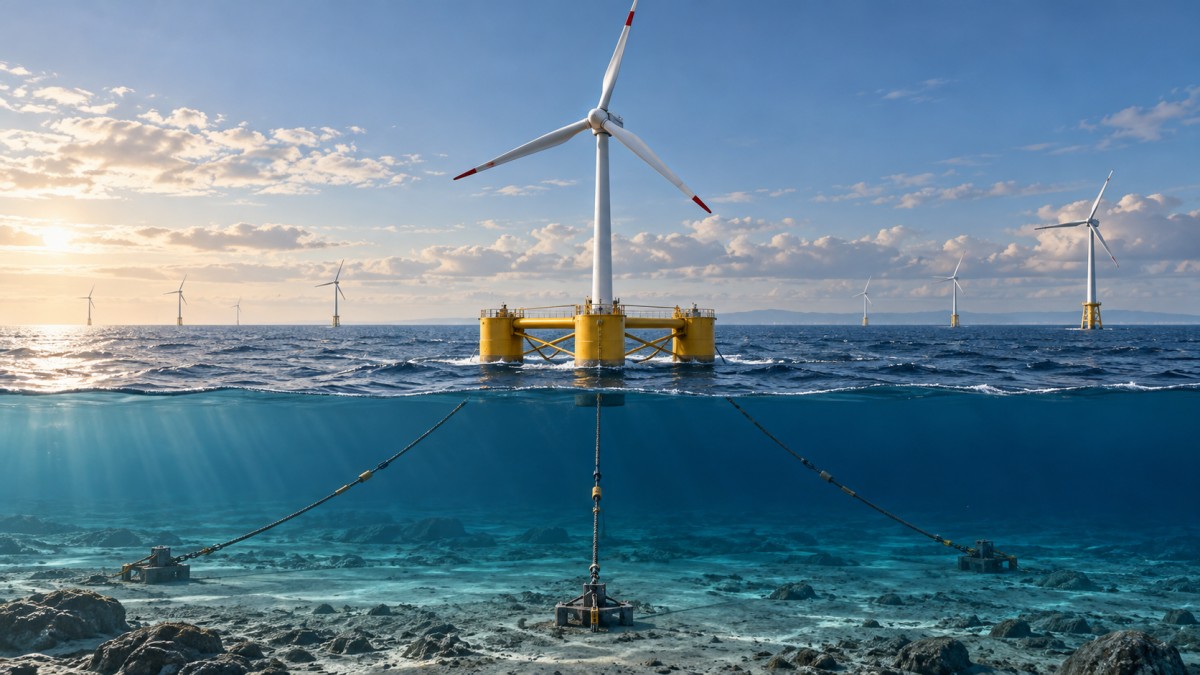
A floating turbine is supported by a buoyant platform held in position by mooring lines and anchors. It does not need a rigid foundation reaching from the seabed to the turbine, but it introduces platform motion, mooring loads and a moving cable interface. The comparison is therefore not “foundation versus no foundation.” It is a comparison between two different load paths, installation sequences and maintenance strategies.
There is no universal water depth at which one concept becomes preferable. Fixed-bottom designs can remain competitive in relatively deep water where seabed conditions, vessels and fabrication capacity support them. Floating concepts may be considered at shallower sites if fixed installation faces exceptional constraints, but shallow water can also restrict mooring geometry and platform clearance. Treat any published depth threshold as a screening assumption, not a design limit.
Start with the site, not the concept drawing
A single depth value hides variation across an array. Bathymetry, seabed slopes and ground conditions may change from one turbine position to another. For a fixed-bottom design, the investigation needs to support decisions about pile penetration, drivability, lateral resistance and potential scour. Rock, hard layers or variable soils can affect both foundation design and installation method.
Floating systems still rely on the seabed. Anchor selection depends on the direction and magnitude of mooring loads as well as soil conditions. A site that is difficult for large driven piles is not automatically straightforward for suction anchors, driven anchors or other anchoring solutions. The mooring footprint must also fit around neighboring turbines, cables, existing infrastructure and any permitted site boundaries.
Metocean data should be assessed alongside geotechnical data. Wind, waves and currents drive structural loads and influence installation windows, vessel station-keeping and maintenance access. For floating turbines, the relationship between wave periods, platform response and turbine control deserves particular attention. A platform that meets a static stability check may still require substantial work on fatigue, motions and control behavior over the operating life.
Where each option tends to gain or lose ground
Fixed-bottom solutions benefit from an established delivery chain where conditions support it. Standardization, fabrication experience and established offshore installation methods can reduce uncertainty. Yet a technically feasible design may become less attractive if it requires a vessel that is unavailable during the construction season, unusually heavy lifts or extensive seabed preparation.
Floating solutions become more compelling when water depth makes a seabed-connected tower increasingly demanding. They can also offer access to wind resources beyond the practical reach of a particular fixed-bottom design. Some concepts allow substantial assembly at port before tow-out, potentially reducing offshore turbine assembly work. That benefit depends on having a suitable port, towing route and installation plan; it should not be assumed from the platform concept alone.
Platform types also carry different constraints. A semi-submersible, spar or tension-leg concept has its own stability, draft, fabrication and mooring requirements. A deep-draft design may face port or route restrictions, while a wider platform may demand more quayside space and towing clearance. Comparing “floating” as a single technology can conceal the very constraints that decide the project.
Installation: the port and vessel plan can reverse the ranking
For a fixed-bottom project, ask whether the planned installation vessel can operate at the site’s depths and soil conditions, lift the proposed components and meet the schedule. Jack-up vessels require suitable seabed conditions and sufficient leg length; floating heavy-lift alternatives bring different motion and lifting constraints. The relevant question is not simply whether a capable vessel exists, but whether it is available with the necessary equipment and crew when the project needs it.
For a floating project, map the full route from fabrication to offshore hookup. Quay load capacity, assembly area, crane reach, water depth, channel clearance and storage space can constrain throughput. Tow-out may require tugs, suitable weather and coordination with anchor and cable installation. If a port upgrade is needed, its permitting, financing and completion date belong in the project risk register—not in an unexamined assumption.
Sequencing matters too. Anchors and mooring lines may be pre-installed, but the hookup operation still needs defined tolerances and compatible equipment. A delay in one work package can leave platforms waiting for offshore access or occupy scarce port space. Compare schedules as integrated marine operations, including contingency and realistic weather restrictions, rather than multiplying an ideal installation time by the number of turbines.
Cables and maintenance are not secondary details
A fixed turbine generally connects to an array cable without a moving platform interface. The cable still needs protection against scour, installation damage and seabed hazards. A floating turbine typically requires a dynamic cable section designed for repeated movement between the platform and seabed. Its configuration, bend limits, fatigue performance, hang-off arrangement and protection strategy must be compatible with platform motions and the chosen electrical design.
Cable routing also has to coexist with mooring lines and anchors throughout installation and operation. Crossing arrangements, separation, inspection and repair access should be addressed before the layout is fixed. A design that fits on a chart may become difficult to install or repair once vessel approach, temporary equipment and seabed congestion are included.
Maintenance assumptions can similarly alter a comparison. Floating platforms may permit tow-to-port repair for some major work, but disconnecting, towing, securing a berth, repairing and reconnecting a turbine can be complex. Other repairs may be performed offshore if access and equipment allow. Fixed-bottom turbines also face offshore access limits and heavy-component replacement challenges. Neither option should receive a generic maintenance advantage without a credible repair strategy, spare-parts plan and estimate of downtime under site conditions.
Compare costs on the same boundary
A foundation-only price is a poor basis for selection. Put fabrication, transport, port works, anchors or piles, installation vessels, cables, commissioning, inspection and major repairs inside the same comparison boundary. Include engineering, insurance, financing and schedule exposure where they differ materially. Decommissioning assumptions should also be consistent and checked against applicable local requirements.
Energy production belongs in the assessment, but it should be based on the same wind-resource assumptions and appropriate loss estimates. A floating design’s access to a windier location may improve the project case, while longer export routes, different electrical losses or availability assumptions can offset part of that benefit. The relevant metric is not simply the cheapest structure per turbine; it is the risk-adjusted project outcome over the period being evaluated.
Be careful with figures transferred from other projects. Currency, date, turbine size, local labor, port investment and scope can change the result. A quoted installation cost that excludes vessel mobilization or port modifications cannot be compared directly with a price that includes them. Request the scope and assumptions behind every benchmark before using it to eliminate an option.
A practical decision gate for technical evaluation
At an early stage, retain both foundation families where the available evidence does not clearly rule one out. Then use a shared set of site and project assumptions to test the most consequential uncertainties:
- Site definition: Confirm the depth range across turbine positions, seabed variability, metocean basis and areas requiring further survey.
- Design interfaces: Check turbine loads, foundation or platform response, anchor or pile feasibility, cable configuration and spatial conflicts.
- Delivery route: Identify candidate fabrication yards, ports, vessels and installation seasons; distinguish confirmed availability from an indicative market enquiry.
- Operating strategy: Define inspection access, credible major-repair methods, spare components and the assumptions behind availability estimates.
- Evidence maturity: Separate supplier projections and proposed projects from demonstrated installation and operating experience under comparable conditions.
The result should be a short list of uncertainties that can change the decision, not just a ranked score. For example, an unresolved port constraint may justify an early engineering study; uncertain soil conditions may justify additional investigation before anchor or pile selection. Give each uncertainty an owner, a date for resolution and a defined effect on cost or schedule.
This distinction between announced capability and demonstrated delivery is central to the approach planned for OffshoreWire, a proposed offshore energy engineering news portal. A project announcement can reveal an intended capacity or technology, but it does not by itself establish that equipment has been installed or operated successfully. For evaluators, the next useful step is to assemble a site-specific comparison record: assumptions, supporting evidence, unresolved interfaces and the milestones needed to close them. Water depth sets the question; that record helps answer it.
Tag
Recommended for You
{item.title}
News Categories
Leave Us a Message