
Offshore Foundations
How Do You Address Recurring Corrosion on Wind Farm Foundations?
How do we handle recurring corrosion on a wind farm foundation? The answer starts with identifying why the existing protection is failing, rather than repeatedly repairing visible damage. For offshore wind operators and engineering teams, corrosion in splash zones, submerged areas, and internal compartments can reflect different combinations of coating breakdown, cathodic protection problems, and site-specific exposure. The right response depends on where the damage is occurring, how quickly it is progressing, and whether the proposed repair can be installed and inspected under real offshore conditions.
A familiar patch of rust returning after a maintenance campaign is more than an aesthetic concern. It may point to an unsuitable coating system, damaged anodes, unexpected water ingress, or a detail that is difficult to prepare properly. It can also be a warning that the inspection strategy is finding symptoms without resolving the underlying mechanism. The challenge is to distinguish a localized maintenance issue from corrosion that could affect structural integrity or the remaining service life of the asset.
Start with the location, not the repair product
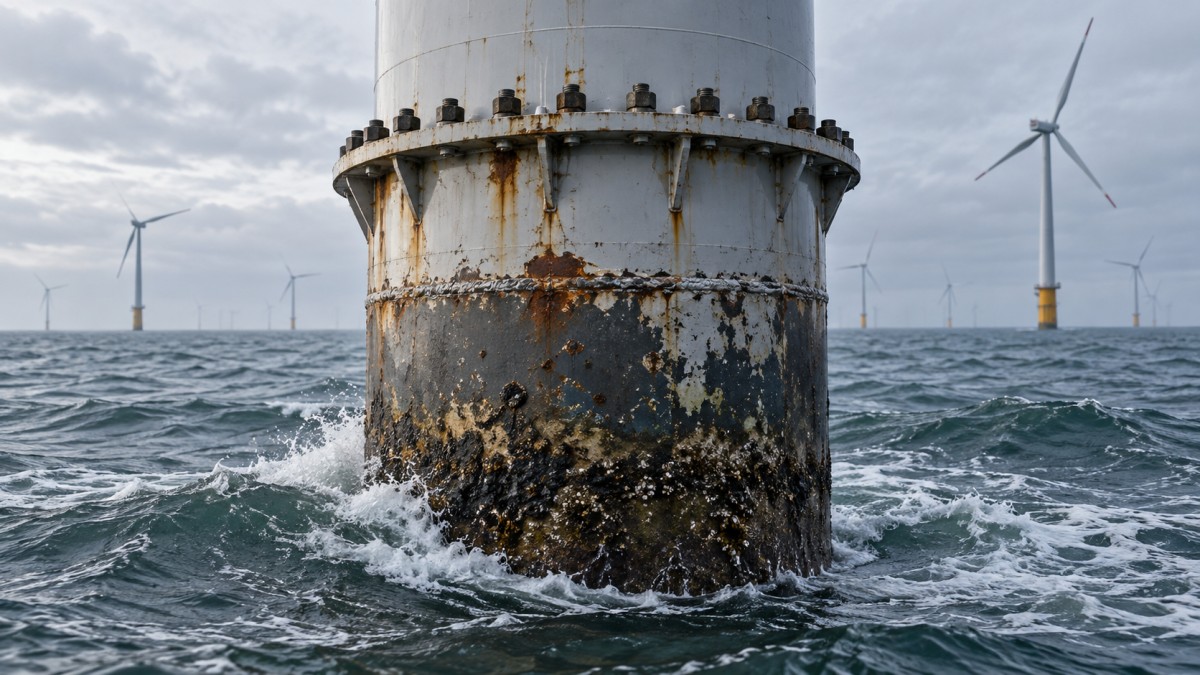
Offshore foundation corrosion is not a single problem. A monopile, jacket, or other steel support structure can experience several exposure regimes at once, each with different inspection and protection requirements.
- Atmospheric zone: Salt spray, humidity, and coating damage around platforms and external fittings can promote corrosion, even where surfaces are not continuously submerged.
- Splash and tidal zones: Repeated wetting, oxygen availability, wave action, and physical impact can make these areas particularly demanding for coatings and repair work.
- Submerged zone: Coatings and cathodic protection commonly work together, but protection depends on electrical continuity, anode condition, and the distribution of protective current.
- Seabed and buried areas: Exposure varies with sediment, oxygen availability, movement of the seabed, and local conditions. These areas can be difficult to access and characterize.
- Internal compartments: Water ingress, condensation, trapped deposits, and restricted ventilation can create conditions that differ substantially from those outside the foundation.
Map the affected locations against elevation, structural details, previous repairs, and changes in exposure. Corrosion concentrated around welds, attachments, cable entry points, or coating edges may tell a different story from broadly distributed surface deterioration. Where possible, compare affected structures with similar foundations in the same farm: a repeated pattern across the fleet suggests a different investigation from a defect isolated to one unit.
What does the evidence say about the cause?
An inspection should do more than catalogue rust. It should produce enough information to test competing explanations and decide whether intervention is urgent. The scope will depend on the foundation type, available records, access, and the suspected mechanism.
Useful evidence can include photographs with consistent location references, coating condition surveys, steel thickness measurements, cathodic protection potential readings, and observations of anode damage or consumption. Internal inspections may also require records of water levels, leaks, deposits, and compartment conditions. Where microbiologically influenced corrosion is suspected, specialist sampling and interpretation may be appropriate; visible deposits alone do not establish the cause.
Review the repair history alongside the inspection results. Ask what surface preparation was specified, what was actually recorded offshore, which coating materials were used, and whether application conditions met the manufacturer’s requirements. A repair that returns at the same edge may indicate incomplete preparation or a difficult-to-protect detail. Damage appearing in a new location may instead reflect impact, movement, or a broader protection issue.
Check whether cathodic protection is performing as intended
Cathodic protection is intended to reduce corrosion of electrically connected steel in an electrolyte. Depending on the design, it may use sacrificial anodes or an impressed-current system. Neither arrangement should be judged solely by whether anodes are visible or equipment is energized.
Measurements need to be taken and interpreted using a suitable reference electrode, an agreed survey method, and applicable criteria. Location matters: a reading at one accessible point does not necessarily demonstrate adequate protection at every attachment, recessed area, or internal surface. Electrical continuity, coating condition, anode consumption, and shielding by geometry or deposits can all affect performance.
More protection is not automatically better. Excessively negative potentials can damage some coatings and may create hydrogen-related risks for susceptible materials. A corrosion specialist should assess the complete system, including any proposed retrofit, against the design basis and relevant project requirements.
Comparing the main responses to recurring corrosion
The best option is not always the most extensive intervention. It is the one that addresses the identified failure mechanism, can be executed reliably, and leaves a verifiable protection system behind.
These approaches can be combined. For example, a foundation may need localized steel repair, a revised coating system in the splash zone, and a separate cathodic protection assessment below water. Conversely, a large recoating campaign may be hard to justify if the evidence points to isolated mechanical damage that can be prevented through a change in access arrangements.
When is another coating repair reasonable?
A localized repair can be a sensible choice when corrosion is limited, steel loss is acceptable, and the surrounding coating has been assessed as serviceable. The specification should address preparation boundaries, treatment of edges and welds, compatible materials, application conditions, and inspection of the finished work.
It becomes less convincing when the same areas fail repeatedly or when access forces crews to compromise on preparation. Offshore coating systems are sensitive to actual surface condition and application environment, not just the product selected onshore. A repair strategy should therefore consider whether the required standard of cleanliness, dryness, and curing can realistically be achieved at the site.
When should the protection system be redesigned?
A broader review is warranted when defects recur across multiple foundations, cathodic protection readings indicate inadequate or uneven protection, or the asset’s operating conditions differ materially from the original design assumptions. The review may lead to changes in anode arrangement, electrical connections, coating specification, water management, or inspection frequency.
For internal spaces, changing the environmental conditions may be as important as treating steel surfaces. Water ingress should be traced to its source where practicable, and any drainage, sealing, or environmental-control measures must be compatible with the compartment design and safety requirements. Introducing a protection system without understanding the internal environment can simply move the problem elsewhere.
Know when corrosion becomes a structural decision
Not every corroded surface requires structural repair, but appearance alone is not a reliable measure of remaining capacity. Localized pitting, corrosion at critical connections, or section loss in highly loaded areas may warrant more attention than a larger area of superficial corrosion.
Where inspection identifies significant or uncertain metal loss, a qualified structural engineer should assess the findings against the foundation’s design, loading, fatigue considerations, and remaining service life. The assessment may require additional measurements or more detailed analysis before a repair scope is chosen. If the condition suggests an immediate safety concern, follow the asset’s escalation and operating procedures rather than waiting for the next planned campaign.
Protection and structural repair answer different questions: the former aims to control future deterioration; the latter addresses whether the structure can continue to perform its required function. Treating one as a substitute for the other can leave a serious gap in the decision.
Make the offshore work executable
A technically sound repair can fail commercially or operationally if it cannot be delivered within the available access window. Before selecting an option, test it against the way the work will actually be performed offshore.
- Access and equipment: Determine whether the task requires rope access, a work platform, divers, remotely operated vehicles, or a vessel with particular capabilities. Check interfaces with the foundation and other activities.
- Weather and sea state: Assess not only whether crews can reach the site, but whether preparation, application, curing, and inspection can be completed within the same workable sequence.
- Safety and environmental controls: Plan for coating debris, marine growth, waste handling, restricted spaces, and applicable local requirements. Internal entry may require a dedicated confined-space assessment and permit.
- Quality assurance: Specify hold points, inspection methods, acceptance criteria, records, and responsibilities before mobilization. Agree how incomplete work will be protected if conditions deteriorate.
- Interfaces and schedule: Coordinate corrosion work with turbine maintenance, electrical isolation, vessel availability, and other campaigns to avoid conflicting access or unnecessary remobilization.
Cost comparisons should cover the full campaign rather than material price alone. Mobilization, preparation, standby time, inspection, potential rework, and future access can change the relative attractiveness of two technically acceptable options. A repair that appears inexpensive in a workshop may be costly if it requires repeated offshore visits.
What should procurement teams ask suppliers?
When reviewing repair systems or corrosion-control proposals, request evidence that relates to the intended duty. A laboratory result, supplier statement, or successful installation elsewhere can be useful, but none automatically proves performance on a foundation with different geometry, exposure, and access constraints.
Ask bidders to define the required surface condition, application limits, compatibility with existing materials, expected inspection method, and treatment of transitions and difficult details. For cathodic protection work, request the design basis, assumptions about electrical continuity and coating condition, commissioning checks, and monitoring plan. Clarify who is responsible for engineering, installation, training, acceptance, and correcting defects.
It is also worth asking what happens if the work stops halfway through. Offshore schedules are rarely immune to weather or equipment interruptions. A proposal that explains how partially prepared steel will be protected, documented, and returned to service is more useful than one that assumes uninterrupted access.
Close the loop after the repair
A completed work pack should record more than the quantity of coating applied or equipment installed. Preserve the defect locations, measured conditions, preparation method, materials and batch information where relevant, inspection results, deviations, and as-built configuration. For cathodic protection, retain commissioning measurements and the basis for interpreting them.
Then set a follow-up inspection plan appropriate to the risk and the chosen intervention. Early checks can establish whether the repair was installed as intended; later inspections show whether it is performing under actual operating conditions. Compare results with the original baseline and with similar foundations, using consistent locations and methods where possible.
Recurring corrosion rarely has a universal fix. The strongest response links the visible defect to a verified cause, compares repair options against their offshore delivery constraints, and measures the outcome afterward. That is how a maintenance team moves from repeatedly covering the same rust to making a defensible decision about the foundation’s long-term condition.
- Last One:No more articles
- Next Article:Floating vs Fixed-Bottom Offshore Wind: When Does Water Depth Matter?2026-11-12
Tag
Recommended for You
{item.title}
News Categories
Leave Us a Message