
Performance Benchmarks
When Should an Offshore Wind Component Be Replaced, Not Repaired?
When should an offshore wind component be replaced rather than repaired? The answer depends on more than visible damage or the cost of a spare part.
Structural integrity, remaining service life, inspection evidence, maintenance access, vessel availability, weather windows, and project downtime can all change the decision.
This article examines the engineering and commercial factors behind repair-or-replace decisions, helping offshore operators, engineers, and procurement teams assess risks in the context of their assets and operating conditions.
When Is Replacement the Better Decision?
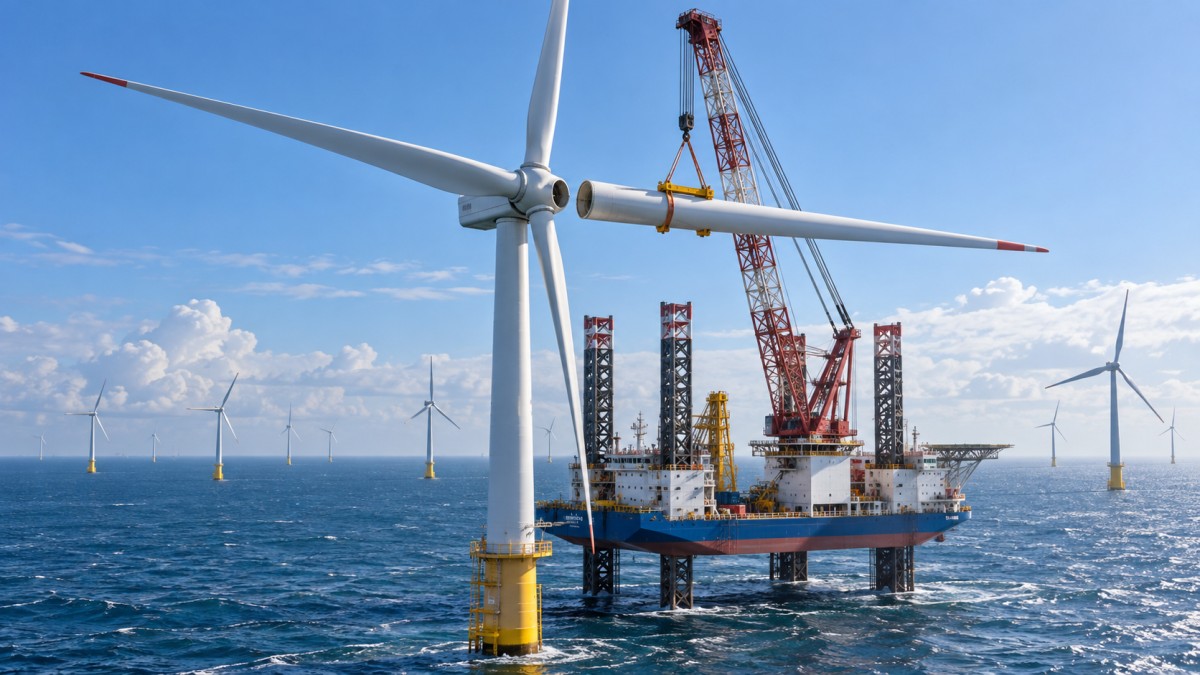
Replacement is generally the stronger option when a component cannot be returned to an acceptable condition, or when a repair cannot provide sufficient confidence for its intended duty.
It may also be preferable when repeated interventions, production losses, and mobilization costs make repair more expensive over the remaining project life, even if the initial repair is cheaper.
Conversely, a documented repair can be appropriate when damage is localized, the failure mechanism is understood, and inspection can verify that the component meets its required performance.
The decision is rarely universal. A blade defect, cable fault, bearing failure, and foundation crack demand different evidence, different repair methods, and different acceptance criteria.
Start by asking whether a technically acceptable repair exists. Only then compare its lifecycle cost, delivery schedule, and residual risk with those of replacement.
Which Conditions Make Repair Unacceptable?
Safety and structural integrity come first. Replace the component when assessment shows that a proposed repair cannot restore the required strength, reliability, electrical performance, or containment.
Extensive damage can exceed a repair method’s qualified limits. Examples include widespread delamination, severe material loss, multiple interacting cracks, or electrical damage beyond the repairable section.
Hidden damage is another concern. If inspection cannot establish the defect’s extent, engineers may be unable to demonstrate that a repair addresses the complete failure.
A repair should also be reconsidered when the original cause remains active. Fixing a damaged bearing without resolving misalignment or lubrication problems may simply restart the failure cycle.
Regulatory requirements, certification conditions, design documentation, warranties, and insurer obligations can restrict available options. Confirm the applicable requirements with the relevant parties before committing to either route.
Where immediate safety is in doubt, isolate or restrict operation according to site procedures. A commercial comparison must not substitute for an engineering assessment.
What Evidence Is Needed Before Deciding?
Begin with a reliable description of the component, its operating history, previous repairs, observed symptoms, and the consequences of failure for people, equipment, and the environment.
Inspection methods depend on the asset. Visual surveys, vibration analysis, oil sampling, electrical testing, and non-destructive testing can each reveal different aspects of a defect.
Review the quality and limitations of that evidence. A remote image may identify surface damage without confirming its depth; a sensor alarm may indicate several possible causes.
Engineers should establish the failure mechanism and estimate whether damage is stable or progressing. Uncertainty matters most when failure could develop before the next accessible inspection window.
Compare the findings with approved design limits and the original equipment manufacturer’s guidance where applicable. An independent assessment may be needed when records are incomplete or recommendations conflict.
Document what remains unknown, how it affects the decision, and whether additional testing would materially change the outcome. Inspection has costs and offshore access constraints too.
How Does Remaining Service Life Change the Calculation?
A repair’s value depends on how long it can support the required duty, not simply on whether it restores operation today. Its expected life should match the operating plan.
For an asset approaching planned decommissioning, a shorter-lived repair may be appropriate if it remains safe, compliant, inspectable, and sufficient for the intended operating period.
For a turbine expected to operate for many more years, recurring repairs may accumulate cost and exposure. Replacement can reduce future interventions if its expected reliability justifies the investment.
Life-extension plans require particular care. A component suitable for the original design life may need further assessment under updated load assumptions, inspection findings, and the proposed extension period.
A replacement is not automatically a life-extension solution. Interfaces, fatigue loading, control settings, and the condition of connected equipment can still limit the upgraded system’s useful life.
How Should Operators Compare Repair and Replacement Costs?
Compare the expected total cost of each technically acceptable option over the same period. Include direct expenditure, production impacts, future interventions, and end-of-life obligations where relevant.
For repair, consider engineering, inspection, materials, technicians, access equipment, vessel time, testing, and any follow-up monitoring. Include the possibility that the repair fails or must be repeated.
For replacement, include the spare component, transport, storage, lifting equipment, vessel mobilization, installation, commissioning, disposal, and any modifications needed to fit the existing asset.
Estimate lost production using expected downtime and the project’s applicable commercial arrangements. Revenue exposure can differ according to electricity prices, contracts, insurance, and the timing of the outage.
Also account for uncertainty. Weather delays, unconfirmed vessel availability, and the discovery of additional damage can alter either estimate materially, so test more than one scenario.
For example, a repair that avoids a heavy-lift vessel may initially appear cheaper. If it is likely to require another campaign, the combined cost could exceed replacement.
Use project-specific probabilities where evidence supports them; otherwise, show a range and state the assumptions. A precise-looking estimate is not a substitute for credible inputs.
Financing and discount rates can affect comparisons across different years. Apply the same financial basis to both options and distinguish cash expenditure from estimated production losses.
Can Offshore Access Make a Good Repair Impractical?
Yes. A technically sound repair can be difficult to execute offshore if it requires long periods of dry conditions, controlled temperatures, specialized technicians, or repeated access.
Weather limits vary by task and equipment. A vessel’s ability to reach a turbine does not necessarily mean technicians can transfer safely or complete a repair to specification.
Replacement may have its own access constraints. A major component exchange can require a suitable heavy-lift vessel, compatible lifting arrangements, port capacity, and a sufficiently long weather window.
Check whether the required vessel and crew are actually available when the work must happen. A quoted mobilization price without a realistic schedule is an incomplete comparison.
Campaign planning can change the economics. Combining several repairs or replacements may spread mobilization costs, but delaying a critical intervention can increase failure and safety risks.
Distance from shore, transfer arrangements, lifting restrictions, and local port infrastructure should therefore be considered alongside the component’s condition, not after the decision is made.
How Do Decisions Differ by Component?
Blades
Localized erosion or a defined structural defect may be repairable when its extent is known and the selected procedure is qualified for the damage and operating conditions.
Replacement becomes more compelling when damage is extensive, structural capacity cannot be demonstrated after repair, or repeated work would require unacceptable access and downtime.
Compare an in situ repair with removal and onshore work as well as full replacement. Each option has different lifting, transport, quality-control, and weather requirements.
Gearboxes, Bearings, and Generators
For drivetrain components, repair may involve replacing a bearing or subassembly while retaining the main unit. Feasibility depends on damage, access, contamination, and available procedures.
Exchange the complete unit when internal damage is widespread, repair quality cannot be verified, or a refurbished or new assembly offers a better supported lifecycle outcome.
Before installation, investigate root causes such as lubrication, electrical problems, or alignment. Otherwise, the replacement may face the same conditions that damaged its predecessor.
Subsea Cables
A localized cable fault may be addressed by removing the damaged section and installing a qualified joint, provided sufficient cable length, compatible materials, and suitable installation conditions exist.
A longer section replacement may be necessary where damage extends beyond a practical repair area, multiple defects are present, or testing cannot establish confidence in the remaining cable.
Assess route access, seabed conditions, burial and protection requirements, joint placement, testing, and available cable stock. A replacement cable must be compatible with existing interfaces.
Foundations and Support Structures
Foundation repairs can include corrosion protection, strengthening, or treatment of a localized defect, subject to engineering assessment and verification of the repaired structure.
Replacement or major structural intervention may be considered when integrity cannot be demonstrated, damage is extensive, or a repair cannot maintain performance under expected loads.
Such work can affect the turbine, seabed, permits, and installation sequence. Decisions require project-specific structural analysis and may involve interventions beyond replacing one discrete component.
What Should Procurement Teams Confirm?
Ask suppliers to define the scope, applicable specifications, interfaces, exclusions, lead time, and evidence supporting their proposed repair or replacement. Request comparable offers wherever practical.
For a repair, confirm the qualified procedure, technician competence, required site conditions, inspection hold points, acceptance tests, monitoring obligations, and expected limitations.
For a replacement, verify dimensions, electrical and mechanical compatibility, lifting interfaces, documentation, software or control requirements, and whether design approval or certification updates are needed.
Clarify warranty terms for both options, including what is covered, who pays for offshore access, and how defects are investigated. A parts warranty may exclude substantial mobilization costs.
Confirm spare availability and delivery commitments against the offshore work window. Also establish ownership of removed equipment, disposal responsibilities, and any restrictions on refurbishment or reuse.
How Should the Final Decision Be Recorded?
A decision record should identify the defect, evidence reviewed, failure mechanism, feasible options, acceptance criteria, cost assumptions, schedule constraints, and the people responsible for approval.
Record the residual risks and the actions needed to control them. For a repair, this may include a defined inspection interval and triggers for reassessment or replacement.
For replacement, retain commissioning results and update maintenance records, configuration information, and spare-parts plans. Confirm that lessons from the failure reach other assets where relevant.
Revisit the decision if inspection results, vessel availability, operating plans, or failure rates change. An option that was reasonable before a new finding may no longer be appropriate.
Conclusion: Choose the Option That Can Be Demonstrated and Delivered
Replace an offshore wind component when a repair cannot meet required safety and performance criteria, cannot be verified, or carries greater expected lifecycle cost and risk.
Repair remains a valid choice when damage is understood, the method is qualified, and the result can support the asset’s planned duty under realistic offshore conditions.
The strongest decision combines engineering evidence with access, scheduling, procurement, and financial analysis. It also states uncertainty clearly and assigns responsibility for checking the outcome.
- Last One:No more articles
- Next Article:Offshore Wind Farm Wake Effects: How Turbine Spacing Affects Yield2026-11-12
Tag
Recommended for You
{item.title}
News Categories
Leave Us a Message