
Performance Benchmarks
Offshore Wind Farm O&M: Reducing Turbine Downtime in Rough Seas
A turbine stopped by a fault can remain offline long after the repair procedure is ready. In rough seas, the limiting factor may be the next safe transfer, the availability of a suitable vessel, or a missing spare part that cannot reach the offshore base in time. Reducing downtime therefore starts before the weather improves: maintenance teams need a credible diagnosis, a prepared intervention package, and a realistic view of the entire access window.
The best response depends on the fault. A remotely resettable alarm may justify immediate investigation from shore; a major component failure may require a separate campaign and a much longer mobilization. For offshore wind farm operations and maintenance teams, the practical objective is to shorten the time between a safe opportunity to intervene and a turbine’s return to service, without treating weather limits as negotiable.
Find out what is actually keeping the turbine offline
Before arranging a vessel, separate the turbine’s technical fault from the factors delaying access. A stopped turbine may have a clear component failure, an ambiguous alarm sequence, or a protective shutdown caused by an external condition. Each calls for a different response. A remote review that narrows the likely failure can prevent a crew from arriving with the wrong tools or being unable to complete the job in the available window.
Start with the alarm history, operating data before the stop, recent maintenance records and any previous recurrence of the fault. Check whether the turbine is fully unavailable, operating under a restriction, or awaiting a manual inspection before restart. Where the control system allows remote diagnostics, compare the evidence with the manufacturer’s troubleshooting procedure and escalation rules. An alarm code alone may identify a symptom rather than the failed part.
Remote resets deserve particular care. A reset can restore operation when the cause is understood and the procedure permits it, but repeated attempts can obscure a recurring problem or leave an unsafe condition unresolved. Maintenance teams should record what was reset, why, and what happened afterward. Where the fault indicates a potential safety or equipment-protection issue, the decision to restart must remain within the approved operating procedure.
When diagnosis remains uncertain, prepare for the most consequential plausible outcomes. That may mean carrying an additional sensor, connector or diagnostic tool if it fits within vessel and handling constraints. It does not mean loading every conceivable spare: the team should understand which checks can be completed offshore, which decisions require technical support, and what evidence would justify returning with a different repair package.
Plan around the whole intervention window
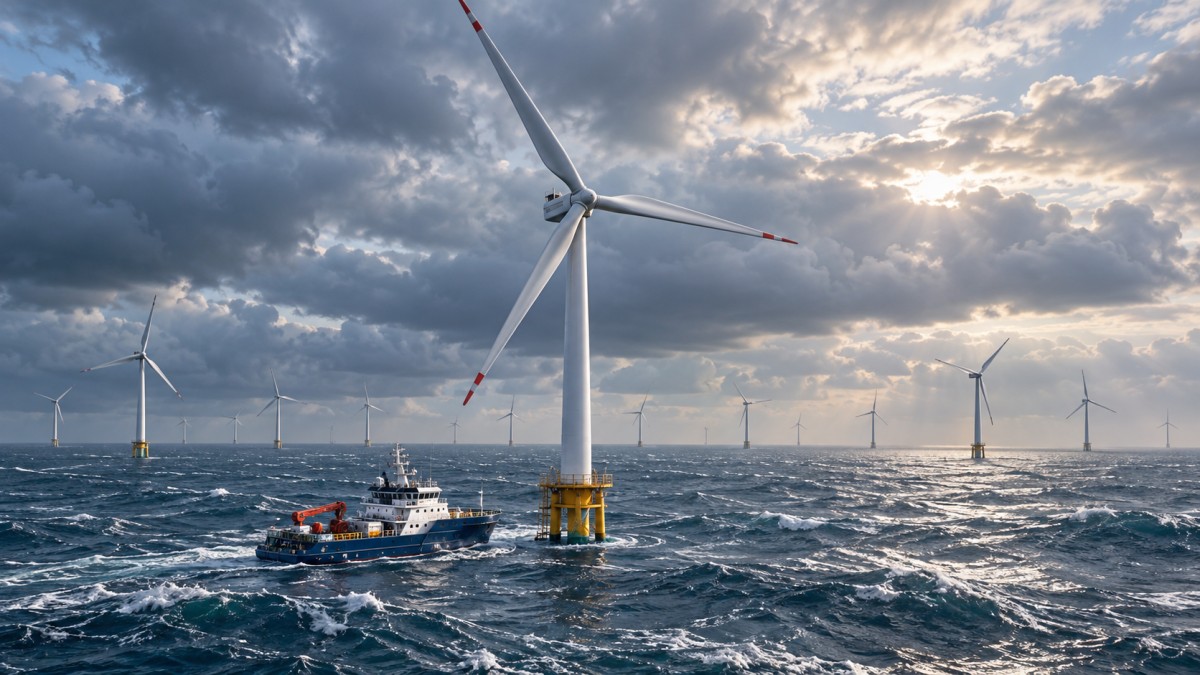
A forecast that permits departure does not necessarily permit transfer, completion of the task and a safe return. Weather-window planning needs to follow the job from the port or offshore base to the turbine and back, including the possibility that the work takes longer than expected.
For a crew transfer vessel, conditions at the turbine landing point can govern the decision even when the wider route is accessible. Wind, waves, visibility, currents, vessel motion and the characteristics of the landing arrangement can all affect a transfer. For a walk-to-work system, access also depends on the vessel, gangway and site-specific operating limits. Neither approach has a universally applicable sea-state threshold: the relevant limits come from the equipment, vessel, procedures and conditions at the time.
Build the schedule backward from the latest acceptable departure or recovery time. Allow for transit, approach, transfer, preparation, isolation, diagnosis, repair, functional checks and return. Consider how a forecast change would affect personnel already on the turbine, and agree on the point at which the job will be stopped or the crew recovered. The vessel master and personnel responsible for the transfer must retain authority to refuse or suspend it under the applicable procedures.
A short weather window may still be useful if the work can be divided safely. A first visit might establish the fault and leave the turbine in an approved state; a later visit can complete the repair once parts are ready. But splitting a job creates extra transfers and may prolong the outage. Use that approach only when the diagnostic value or preparation gained outweighs the added exposure and logistics.
Choose access for the task, not just the forecast
The access method should match both the expected conditions and the intervention. A crew transfer vessel may be appropriate for a short task when transfer conditions and transit time are favorable. A service operation vessel with a motion-compensated gangway may support access and offshore accommodation over a longer campaign, but its suitability still depends on operating limits, turbine interfaces, availability and cost. Helicopter access, where permitted and available, has its own weather, landing or hoisting, personnel and equipment constraints.
None of these options removes the need to bring the right tools and parts. An access system can put technicians near a turbine while the required component remains at the port. Before changing vessel strategy, compare the expected gain in workable access with the likely duration of the repair, the number of turbines that can benefit, and the readiness of the work packages. A higher-capability vessel may be difficult to justify for an isolated minor fault but more useful when several prepared jobs can be completed during the same deployment.
Make the first safe visit count
Once a fault has been triaged, convert the diagnosis into a job package that can be executed without avoidable offshore decisions. The package should identify the work scope, isolation and permit requirements, technicians and competencies, tools, spare parts, lifting or handling arrangements, and the checks needed before return to service. It should also identify who can provide engineering support if the fault differs from the expected condition.
For after-sales teams, the handover between the operator, turbine manufacturer, service provider, marine coordinator and vessel crew is often as important as the repair instruction itself. Each party needs the same understanding of the turbine status, the intended task and the point at which the plan changes. A component can be physically available yet unusable because its configuration, documentation or compatibility has not been checked.
- Confirm the scope: distinguish inspection, temporary restoration and permanent repair. Identify the conditions that would make the crew stop or change the task.
- Check the parts: verify the correct variant, condition, packaging and any storage or handling requirements. Make sure small consumables and replacement fasteners are included where required.
- Match the crew to the work: confirm authorization, equipment-specific competence and the availability of remote technical support during the planned window.
- Prepare the marine interface: communicate personnel numbers, cargo dimensions, transfer arrangements and any special handling needs to the vessel team.
- Define the closeout: agree on inspection records, functional tests, alarm review and operational checks needed before the turbine is handed back.
Staging decisions should reflect both failure consequences and logistics. Frequently used, compact parts may be worth holding close to the site; expensive or rarely used assemblies may be better managed through a regional pool, provided transport arrangements are credible. For each critical item, the question is not simply whether it is in stock, but how quickly it can be identified, released, transported and safely transferred when the turbine is unavailable.
Major components need separate treatment. A gearbox, generator or blade intervention may require specialized lifting equipment, engineering approval, vessel availability and a longer weather window. Preparing those dependencies early can reduce idle time, but the work should not be scheduled as though it were a routine technician visit.
Prioritize work when access is scarce
Several turbines may be waiting when a workable window opens. The first job should not automatically be the one that has been down longest. Rank interventions by safety and environmental significance, likely recoverable generation, probability of completing the task, resource readiness and the consequences of further delay. Any mandatory safety action or operating restriction takes precedence under the site’s procedures.
A straightforward repair on a stopped turbine may be a strong candidate if the crew, parts and verification steps are ready. An uncertain fault on another turbine may justify a diagnostic visit if it could unlock a larger repair plan. Preventive work can also merit a place in the schedule when postponement would increase the risk of a more disruptive failure, but it should be weighed against immediate restoration opportunities.
Grouping nearby tasks can reduce transit and make better use of vessel time. The constraint is that each additional visit consumes part of the window and introduces another transfer decision. Plan a primary job and a realistic alternative rather than a list that can be completed only if every activity goes perfectly. If conditions deteriorate, the fallback should already identify which work can be deferred and how the crew will leave the turbine in an approved state.
Measure delay in a way the team can act on
Downtime reporting is more useful when it shows where time was lost. A single outage duration combines fault detection, diagnosis, waiting for parts, vessel mobilization, weather delay, repair and return-to-service checks. Those categories need consistent definitions, including how overlapping delays are handled; otherwise, the figures can point to the wrong corrective action.
For example, a turbine may be recorded as waiting on weather while a spare is also unavailable. Improving access would not have restored it during that period unless the part had arrived. Conversely, a part delivered quickly has limited value if no suitable vessel or crew can be mobilized when conditions permit. Record both the primary constraint and relevant concurrent constraints, then review which one actually governed the earliest feasible intervention.
Track repeat visits and incomplete jobs as well as outage duration. A high number of repeat visits may indicate weak diagnosis, missing equipment, an underestimated task duration or a fault that was not fully resolved. Compare similar jobs across seasons and access methods, keeping the observation period and scope clear. A short sample of favorable weather should not be treated as proof that a vessel strategy will perform equally well throughout the year.
After the turbine returns to service, close the loop with the people who planned and executed the work. Record the observed failure, parts used, any departure from the expected scope and the evidence from functional checks. Those details make the next intervention easier to prepare, especially when a similar alarm appears before the next difficult-weather period.
The most useful operating plan is one that remains credible when the forecast, diagnosis or vessel availability changes. A prepared crew with a clear stop point, an accessible spare and an agreed recovery plan can use a limited safe window effectively; without those conditions, a window on the forecast may pass without restoring the turbine.
Tag
Recommended for You
{item.title}
News Categories
Leave Us a Message