
Subsea Cables
Offshore Wind Grid Connection: HVAC vs HVDC for Distant Projects
For distant offshore wind projects, the choice between HVAC and HVDC can shape transmission losses, offshore platform design, installation scope and long-term operating risk. Yet distance alone does not determine the best solution. Project capacity, cable route, grid requirements, converter availability and maintenance access also matter. For technical evaluators, the task is to compare an offshore wind farm grid connection as a complete delivery system—not simply as a choice between alternating and direct current.
The decision can become uncomfortable when an early screening study points toward one technology while the available grid connection, procurement schedule or offshore construction plan points toward another. A useful comparison makes those tensions visible before the project commits to a platform layout or export corridor that is difficult to change.
What changes when the export route gets longer?
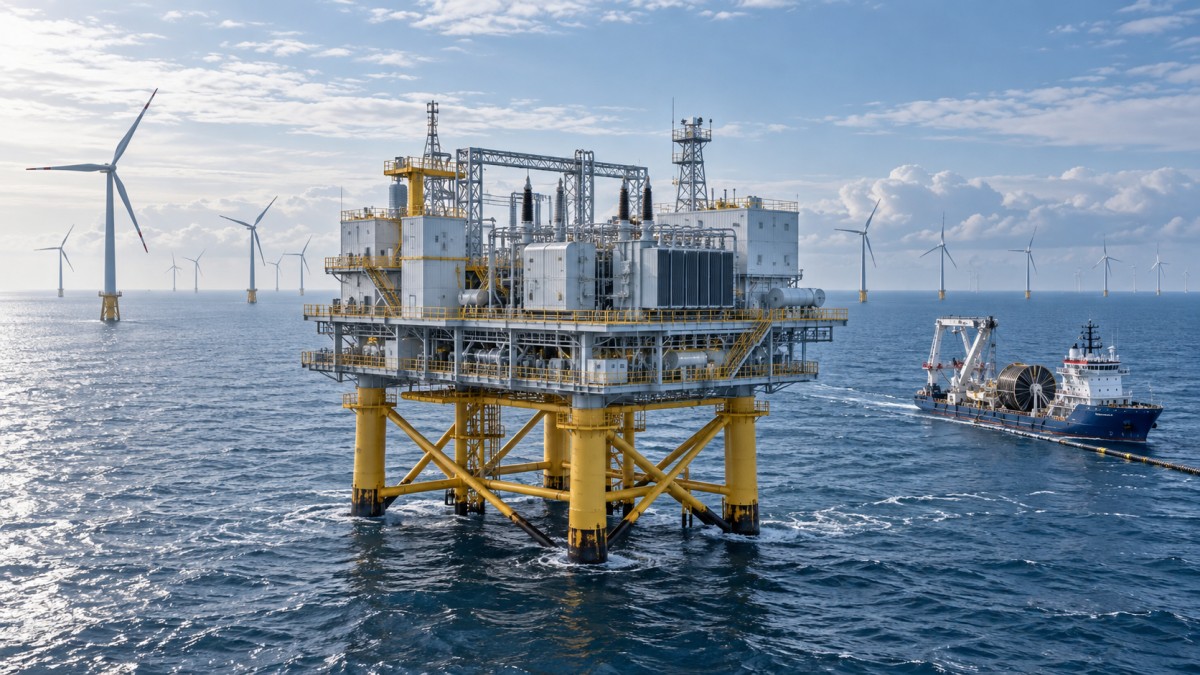
High-voltage alternating current (HVAC) export systems use offshore transformers to raise the wind farm’s AC collection voltage for transmission. At shore, further transformation and reactive power equipment may be needed before connection to the onshore grid. HVAC benefits from a familiar equipment base and avoids the large converter stations required by HVDC, although its offshore and onshore arrangements can still be substantial.
High-voltage direct current (HVDC) systems convert the wind farm’s AC output to DC offshore, transmit it through submarine cables, then convert it back to AC onshore. For modern offshore wind applications, voltage-source converter technology is commonly considered because it offers controllable power transfer and useful voltage-support capabilities. These capabilities depend on the converter design and the applicable grid code; they are not unlimited substitutes for a strong grid.
Long AC submarine cables produce significant capacitive charging current, which consumes part of their current-carrying capability and creates reactive power management challenges. Compensation can extend the practical range, but it adds equipment and complexity. DC cables do not have the same steady-state charging-current constraint, making HVDC increasingly attractive as routes lengthen or transmitted capacity rises.
There is no universal crossover distance. Published rules of thumb often assume different capacities, cable designs, compensation arrangements, loss valuations and cost boundaries. A route with difficult landfall works or constrained grid access can change the answer as much as another stretch of seabed.
HVAC vs HVDC: compare the whole connection
The table is a starting point, not a ranking. An HVAC design may need several export circuits to carry a large project’s output, while an HVDC design may concentrate more capacity in a converter system. The consequences for installation, outages and expansion depend on the actual circuit and station configuration.
Start with the electrical boundaries, not the map distance
Two projects the same distance from shore can have very different connection problems. The relevant length is the engineered cable route, including deviations around seabed hazards, existing assets, protected areas and landfall constraints. Onshore cable length to the point of connection also belongs in the study.
For each candidate, define the export capacity, voltage, number of circuits, conductor size and normal operating configuration. Assess cable thermal ratings using representative burial conditions and soil properties, including sections where cables are closely spaced or cross other infrastructure. A design that works under average seabed conditions may be limited by a short, thermally restrictive section of the route.
The wind farm’s production profile matters too. Comparing losses only at rated capacity can misrepresent annual energy performance because wind farms operate across a range of outputs. A meaningful assessment models expected generation, electrical losses and availability over time, then applies a stated value to energy delivered or curtailed. Assumptions about degradation and future prices should be visible rather than hidden inside a single lifetime-cost figure.
Test the grid connection as part of the design
The point of connection may impose requirements for fault ride-through, reactive power, voltage control, harmonics, protection coordination and power quality. Weak-grid conditions can make converter controls or AC compensation particularly important. In either case, studies should include the wind turbines, offshore network, export system and relevant onshore grid representation—not just the export cable in isolation.
Ask the network operator what connection capacity is secured, what reinforcement is assumed and when it is expected to be available. A technically sound export system cannot deliver its intended value if the onshore works arrive later than the offshore project. Record whether connection terms are preliminary, agreed or subject to further study.
Platform and vessel choices can shift the result
HVDC’s offshore converter station can be a major construction package. Its topside mass, footprint, foundation or floating-support concept, cooling arrangements and maintenance access affect fabrication, transportation and installation. The project must confirm that the required port facilities and installation vessels are available within the schedule, and that lift, deck and weather limitations match the selected design.
HVAC platforms can also grow materially when transformers, switchgear, reactors and auxiliaries are brought together. If the project needs multiple platforms or export circuits, their combined installation campaigns and interfaces should be counted. Comparing one HVAC platform with one HVDC platform, while leaving the remaining AC infrastructure outside the boundary, produces a misleading result.
For both options, cable installation risk extends beyond the manufacturer’s delivery date. Route clearance, seabed preparation, burial tools, crossing agreements, cable protection and post-installation testing can govern the critical path. Water depth, seabed mobility and metocean conditions affect which methods are feasible and how much weather contingency is appropriate.
Availability is a system property
A low-loss design is not necessarily the connection that delivers the most energy. An export cable fault, converter outage or failed transformer may remove a large share of capacity while a repair vessel, spare component or specialist team is mobilized. The exposure depends on redundancy, fault location, repair strategy and whether the remaining equipment can carry partial output.
Evaluate credible outage scenarios rather than assuming a single availability percentage for each technology. For example, compare the effect of losing one AC export circuit with losing an HVDC pole or converter module, using the actual proposed configuration. Determine what can continue operating, what protection actions are required and how quickly the fault can be isolated.
Maintenance access deserves equal attention. Offshore converter equipment may require specialist personnel and carefully planned access; remote AC equipment also has inspection and repair needs. Review accommodation, transfer limits, remote diagnostics, spare parts, service contracts and the ability to perform work during the local weather season. For cables, identify repair bases, compatible vessels, spare cable lengths and the permissions needed to intervene.
Build a defensible commercial comparison
The most useful cost comparison places both options within the same scope and time horizon. It should include development and engineering, equipment, platforms, foundations, export cables, landfall, onshore works, installation, commissioning, losses, operations, maintenance, expected outages and end-of-life obligations where applicable. Financing and schedule effects should be treated consistently.
Do not assume that an early supplier indication represents a firm project price. Confirm what is included, the maturity of the design, delivery slots, warranty conditions and exclusions. HVDC converter packages may involve significant interfaces between the converter supplier, platform contractor, cable supplier, wind turbine suppliers and grid operator. HVAC procurement also requires clear responsibility for compensation, protection settings, cable terminations and system studies.
Run sensitivities around the assumptions most likely to move the decision: route length, circuit count, losses, energy value, platform mass, vessel availability, converter lead time, repair duration and the date of onshore grid reinforcement. If a small change reverses the preferred option, the study has identified a decision that needs better evidence—not a winner that should be presented as certain.
Questions to put to bidders and engineering teams
- What route length, burial conditions, cable rating and operating temperature underpin the proposed export capacity?
- Which grid-code obligations are covered, and which studies or equipment remain outside the offer?
- What is the expected loss profile across different power levels, including transformers, converters and auxiliary consumption?
- What are the platform weight, installation assumptions and vessel or port dependencies?
- How is partial operation handled after a cable, converter, transformer or switchgear failure?
- Which factory, integration and site acceptance tests are planned, and who owns the interfaces?
- What delivery dates are supported by an actual manufacturing slot, and what remains indicative?
- How can the system accommodate later capacity changes, and what equipment would need replacement or additional consent?
When each option deserves closer examination
HVAC is often a strong candidate when the route and required capacity can be accommodated without disproportionate reactive compensation or an excessive number of circuits. It may also suit a project where a comparatively straightforward connection architecture and available equipment align with the construction schedule. That does not remove the need to model charging current, grid compliance and the full installation scope.
HVDC deserves close examination when a long submarine route, high export capacity or demanding grid interface makes AC transmission increasingly difficult. Its controllability can be valuable, but the benefit must justify converter losses, station investment and delivery complexity under the project’s actual operating conditions. A future network or expansion concept should be evaluated on its own technical and commercial merits; an HVDC connection should not be assumed to be automatically ready for an interconnected offshore grid.
The decision is ready to advance when both options have been tested against the same electrical boundaries, route evidence, grid assumptions and delivery schedule—and when the remaining uncertainties are assigned to owners. For a distant offshore wind farm grid connection, the best choice is the one the project can construct, connect and maintain reliably, not simply the one that looks preferable on a distance chart.
- Last One:No more articles
- Next Article:What causes subsea cables to fail at crossings?2026-11-12
Tag
Recommended for You
{item.title}
News Categories
Leave Us a Message