
Installation Vessels
Should You Sign a Long-Term Cable Repair Vessel Agreement?
Should we sign a long-term vessel agreement for cable repairs? For offshore wind developers and asset owners, the answer depends on more than securing a vessel at an attractive rate. Cable failures can disrupt operations, while vessel availability, mobilization time, equipment compatibility and weather limits all affect repair readiness. The decision is whether reserved access removes enough outage risk to justify its fixed cost—and whether the contract actually delivers the resources needed to complete a repair.
A long-term agreement is most compelling when the financial consequences of waiting are high, suitable vessels are difficult to obtain at short notice, and the owner can demonstrate that the contracted spread fits its cables and operating area. It is less compelling when the agreement offers little more than a place on a waiting list or when spares, permits and repair engineering would still delay the work.
What are you actually reserving?
The phrase “long-term vessel agreement” can describe several arrangements. At one end is a dedicated vessel, kept available for a particular owner. At the other is a framework with agreed rates and administrative terms but no firm obligation to release a vessel immediately. Between them are priority-access and shared-pool arrangements, in which several assets or owners fund access to repair capacity.
Those options do not offer the same protection. A framework can reduce negotiation time after a fault, but it does not necessarily shorten the wait for a vessel already working elsewhere. A priority clause may help, but only if it defines who has priority over whom, when the obligation begins and what happens if the vessel cannot be released. A dedicated vessel provides more control over availability, although the owner pays for capacity even when no repair is needed.
The commercial question therefore starts with a plain-language test: if a cable failed tomorrow, which vessel, crew and equipment would be committed, and what would stop them from sailing? Ask the provider to answer using the actual contract terms rather than a general description of its fleet.
Model the whole outage, not just the vessel day rate
A cable failure can affect an individual turbine string, a larger section of an array or an export route. The resulting loss depends on the network configuration, the point of failure, generation conditions and any alternative operating arrangements. Two assets with similar installed capacity can therefore have very different exposure to the same repair delay.
Build the comparison around the expected cost of the full incident: fault location, engineering, vessel access, mobilization, repair, testing and return to service. Include the reservation fee, call-out charges, offshore day rates, port costs, specialist personnel, spare cable and jointing materials. Also examine the treatment of weather standby, fuel, subcontractors and demobilization. A lower day rate can be outweighed by a longer wait or by charges outside the quoted scope.
The analysis should also reflect insurance. Review deductibles, waiting periods, coverage limits and any conditions attached to repair choices with the insurer or broker. Insurance may reduce the owner’s retained loss, but it does not automatically make every outage cost recoverable. Contractual obligations to power purchasers, lenders or other project parties may also affect the value of a faster return to service.
There is no universal break-even reservation fee. Compare at least three cases: spot-market procurement, a priority or pooled agreement, and a more exclusive commitment. For each, vary the assumed fault frequency, delay before mobilization, weather interruption and production loss. Use project records and market inquiries where available, and make the source and time frame of each assumption visible. If a small change in one assumption reverses the result, the decision deserves further investigation rather than a more elaborate spreadsheet.
A vessel is only one part of repair readiness
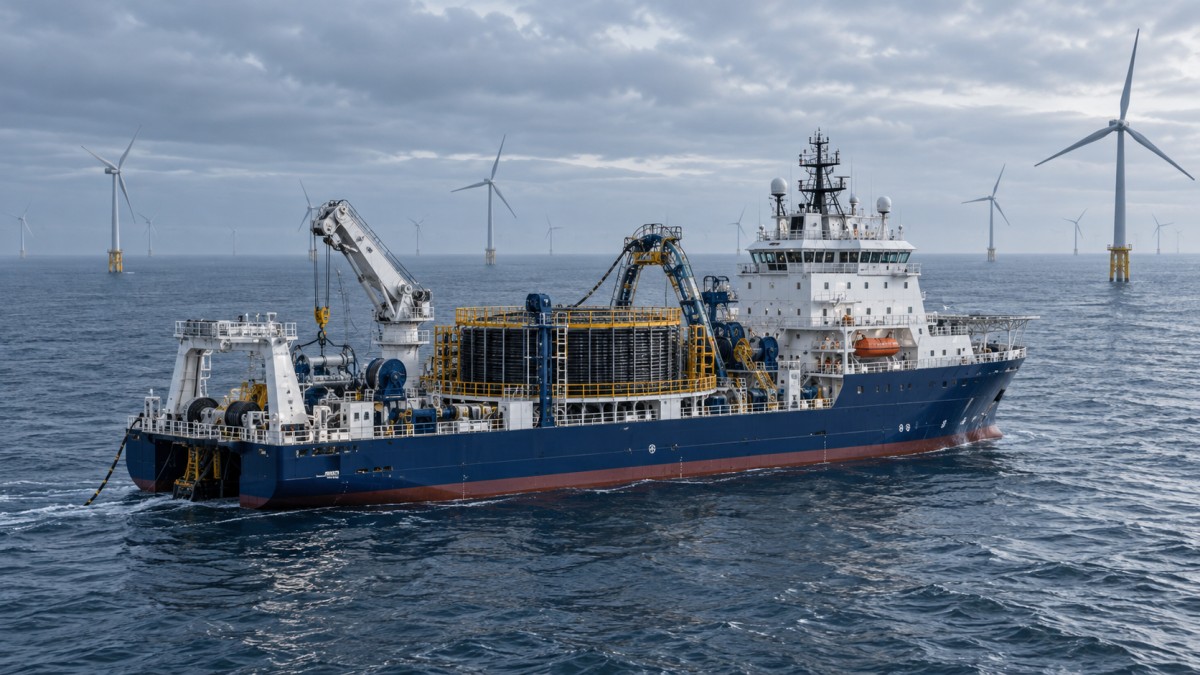
A suitable hull does not guarantee a suitable repair spread. The vessel must be able to handle the cable safely, operate at the relevant water depth and maintain position within the site’s constraints. Deck space, lifting arrangements, cable storage, tension control and the interfaces for jointing or testing equipment all matter. So do seabed conditions and the method needed to expose, recover and re-protect the cable.
The available vessel may be compatible with an inter-array cable but not the owner’s export cable, or it may need additional equipment before a particular repair can begin. Ask for a documented interface review against cable dimensions, bend limitations, handling loads, water depth and the intended repair method. Confirm whether the proposed equipment is already on board, held at a named location or subject to a separate subcontract.
Spare cable and joints can be just as consequential. Check their compatibility, storage condition, ownership and access arrangements, including who is authorized to release them. A repair may require more than a replacement length: the plan must account for recovery, suitable joint locations and the additional cable needed by the selected method. These quantities should be established through project-specific engineering, not a generic allowance in the vessel contract.
Port access is another frequent interface. The selected port must be able to receive the vessel and support the required loading, personnel transfers and storage. If specialist technicians must travel from another jurisdiction, their availability and any applicable work or entry requirements belong in the mobilization plan. A response promise measured only to vessel departure leaves these steps unresolved.
Make the response clock meaningful
A contract that promises a response within a stated period can still leave considerable uncertainty. Does the clock start when the owner reports a suspected fault, when the fault is confirmed, or when the contractor accepts a formal call-out? Does “response” mean acknowledging the request, assigning a vessel, reaching port or arriving at the worksite?
Define separate milestones for notification, resource confirmation, mobilization and arrival, with the assumptions attached to each. The agreement should identify the vessel’s expected operating region and explain how commitments change if it is already on another assignment. Where a substitute vessel is permitted, require evidence that it meets the same technical and equipment requirements, not merely that it is available.
Exclusions deserve equal attention. Weather, safety restrictions, port access, regulatory permissions and force majeure can affect performance, but the parties should agree how delays are reported and documented. A useful agreement also specifies escalation routes, remedies for failure to provide committed resources and any caps on liability. Remedies need careful review: a modest refund of the reservation fee may be of limited comfort during a prolonged outage.
Weather can defeat a fast mobilization
Reaching the site quickly is not the same as starting work. Cable recovery, lifting, jointing and reburial may each have different operating limits. The relevant window is the period in which the planned sequence can be completed safely, not simply a forecast showing that the vessel can transit or remain on location.
Ask the contractor to identify the limiting operations and the basis for its weather assumptions. Compare those assumptions with the site’s metocean information, season and repair method. Historical weather-window estimates are only useful when their location, observation period and calculation method are understood. They are not a promise that the next repair will fit the historical pattern.
The contract should also state who decides to wait, how standby is charged and whether the vessel can leave for other work during an extended interruption. If another customer can call it away, the owner needs to know how quickly it can return when conditions improve.
When shared access makes sense—and when it does not
A shared repair pool can spread fixed costs across several assets, particularly when their cable systems, operating areas and technical requirements are compatible. It may also support common spares or pre-agreed engineering. For an owner with a small portfolio, this can be more practical than funding exclusive access alone.
The weakness appears when more than one participant needs the spread. Storms, third-party damage or separate faults may create competing calls. The allocation rules should explain how simultaneous incidents are prioritized, whether an ongoing repair can be interrupted, and who pays for repositioning. Geographic diversity can reduce the chance of competing calls, but it can also increase transit time; the balance depends on the participating assets and vessel locations.
A spot-market approach may remain reasonable where outage exposure is manageable, repair resources are demonstrably accessible, or the asset is close to a planned retirement or major redesign. Even then, owners benefit from preparing cable records, spare-part arrangements and a repair scope in advance. Waiting until a fault occurs to establish basic compatibility can consume time regardless of the procurement model.
Before signing, test the agreement against a credible fault
Run a tabletop exercise using a plausible failure on the most consequential cable route. Trace the sequence from isolation and fault location to return-to-service testing. Identify who makes each decision, who supplies each component and which activities can proceed in parallel. Include the vessel provider, operations team, cable specialists, port representatives and relevant insurers or advisers where appropriate.
The exercise should produce a short list of evidence to close before award: confirmed vessel and equipment interfaces; current cable and route records; spare inventory; a realistic mobilization plan; required permissions; and an agreed testing and handover process. Responsibilities for environmental management, waste handling and seabed reinstatement should be checked against the project’s permits and applicable local requirements.
Revisit the arrangement as the portfolio changes. A new export route, revised operating strategy or different cable type may alter both the financial case and the required repair spread. The same applies when a provider changes the vessel or subcontracts a critical service.
OffshoreWire, a proposed industry information portal, frames decisions like this around the connection between vessel capability, project delivery and supply-chain constraints. For an owner preparing to commit, the practical next step is to compare offers against one documented fault scenario—not just their reservation fees. Sign when the agreement demonstrably reduces the delays that matter for that asset, and when the remaining dependencies are understood and assigned.
- Last One:No more articles
- Next Article:Choosing wind turbine installation vessels for deep water2026-11-12
Tag
Recommended for You
{item.title}
News Categories
Leave Us a Message