Offshore Hydrogen
Is Offshore Hydrogen Production Feasible Without a Grid Connection?
Yes, offshore hydrogen production is feasible without a grid connection. An offshore wind farm or another local power source can supply electricity directly to electrolyzers, which split treated water into hydrogen and oxygen. The harder question is whether the complete system can produce, store and deliver hydrogen reliably enough to justify its cost at a particular site.
Removing the grid connection also removes a source of balancing power and a route for selling excess electricity. The project must manage wind variability, supply essential equipment during outages, handle hydrogen safely and reach a customer by pipeline or vessel. An electrically isolated plant can work, but it cannot be designed as an electrolyzer attached to a wind turbine with the remaining details left until later.
What does “without a grid connection” mean?
For this discussion, an off-grid offshore hydrogen facility has no electrical connection to an onshore or wider power grid. It may still have an internal electrical network linking turbines, power converters, electrolyzers, batteries and platform equipment. It may also have a hydrogen pipeline to shore: a pipeline is an export route for the product, not an electrical grid connection.
That distinction matters when comparing projects. A facility that uses grid electricity during calm periods has a different operating profile from one dependent entirely on local generation. Similarly, a plant with a hydrogen pipeline has different storage, compression and maintenance requirements from one that relies on periodic vessel collection.
A practical comparison should cover the whole chain: generation, power conditioning, electrolysis, water treatment, hydrogen conditioning, storage and delivery. It should also include the equipment that keeps the facility safe when hydrogen production stops.
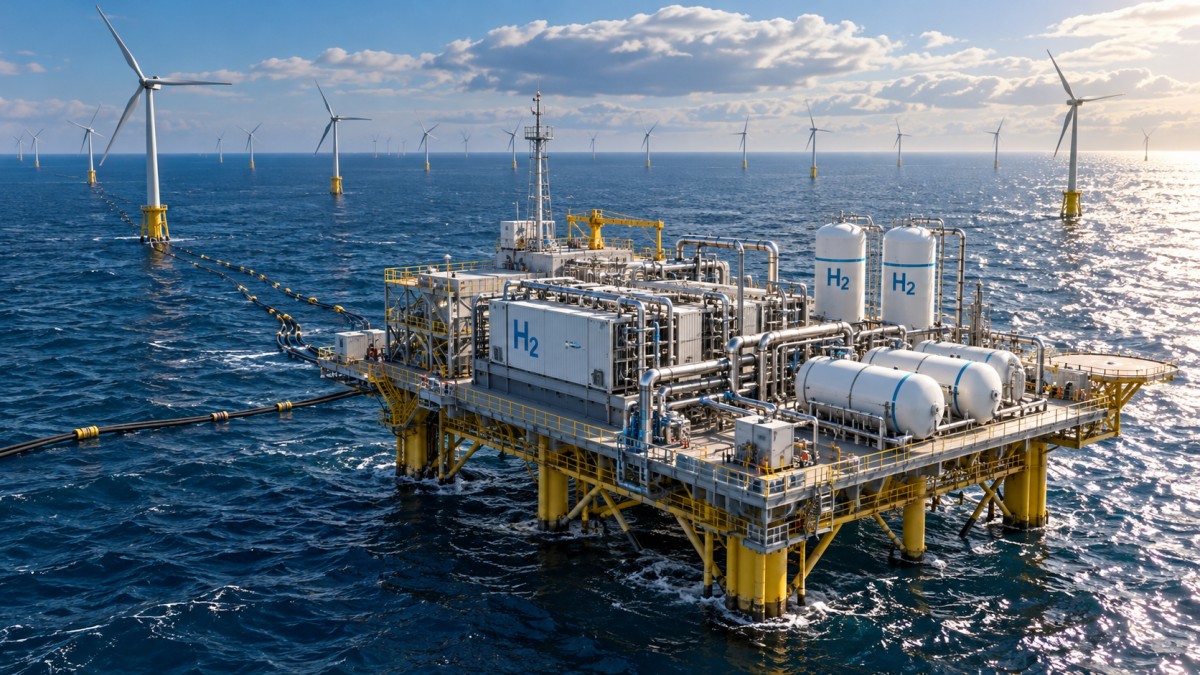
Off-grid offshore production versus grid-connected alternatives
None of these arrangements is automatically cheapest. An offshore hydrogen pipeline may be attractive where a suitable route and demand exist, but its cost depends on distance, seabed conditions, capacity, landfall and permitting. An electrical cable has its own installation, protection and connection costs. Both options require maintenance and exposure to offshore construction risk.
Moving electrolysis offshore can reduce the need to bring all generated electricity ashore, but it places more process equipment in a difficult environment. A fair comparison therefore includes the platform or turbine integration, marine installation, export system, power supply, maintenance and decommissioning, not just the price of the electrolyzer or cable.
Variable power changes the design of the plant
Wind power rarely matches a fixed production schedule. During high-wind periods, available power may exceed what the electrolyzers can use. During low-wind periods, production may fall or stop. The plant must be designed around the actual range and sequence of expected operating conditions, not simply the wind farm’s nameplate capacity.
Electrolyzer technologies differ in how they respond to changes in power, minimum operating load, shutdowns and restarts. Those differences affect output and equipment wear, but the relevant figures depend on the specific equipment and operating profile. A procurement specification should ask suppliers to show how their system behaves across the expected duty cycle, including repeated starts, prolonged low-power periods and trips.
Developers can use several approaches to manage variability:
- Flexible operation: adjust hydrogen output to follow available power, accepting periods of low or zero production.
- Electrical storage: use batteries or another storage system to smooth short fluctuations and support controlled operation. Storage must be sized for a defined purpose; it does not automatically solve long periods of low wind.
- Oversized generation or staged electrolyzers: configure the plant so that part of the electrolyzer capacity can operate when power is limited, while accepting potential curtailment at other times.
- Backup generation: provide power for essential systems or restart capability. Its fuel supply, emissions, maintenance and contribution to hydrogen production must be included in the project assessment.
The best combination depends on the buyer’s delivery requirements as well as the wind resource. A customer able to accept variable volumes may allow a simpler plant than one requiring a steady supply. Hydrogen storage can help bridge that gap, but it shifts costs and risks into compression, containment and inventory management.
Plan for a plant that has stopped producing
An off-grid facility still needs power when the wind is insufficient for electrolysis. Control systems, communications, monitoring, ventilation, emergency equipment and other essential loads may need to remain available according to the safety design. The project also needs a defined shutdown and restart sequence, including what happens after a prolonged outage.
This is a separate question from maximizing annual hydrogen output. A battery sized to smooth brief changes in wind generation may not be adequate to sustain essential services through a longer interruption. Backup arrangements need to be assessed against the site’s weather, access constraints and required recovery time.
Water is available offshore, but suitable feedwater is not automatic
Electrolyzers require water treated to the quality specified for the selected equipment. Seawater is not normally fed directly into a conventional electrolyzer: it must pass through desalination and further treatment as required. The water system also needs intake arrangements, pumps, monitoring, consumables and a plan for managing discharges.
Water treatment consumes power and occupies space. Its operation must be coordinated with the electrolyzer, particularly when generation is intermittent. Feedwater storage may allow treatment and production to run on different schedules, but storage adds weight and requires protection against contamination.
Intake reliability and discharge conditions also affect the site design and permitting process. A compact unit that works well onshore may need different protection, maintenance access and redundancy offshore. The relevant question is whether the entire water system can deliver the specified quality under the facility’s operating conditions.
Getting hydrogen to shore can decide the project
Producing hydrogen is only useful if it can be delivered in a form and quantity the customer can accept. The export choice affects pressure, compression, storage, platform layout, operating schedule and the commercial agreement with the buyer.
Pipeline export
A dedicated hydrogen pipeline can support continuous or variable delivery without waiting for a vessel. It may suit a project with a sufficiently large, long-term offtake and an acceptable route to shore. Its feasibility depends on route engineering, landfall, seabed conditions, construction access and the receiving infrastructure onshore.
Compression and hydrogen conditioning must be designed around the pipeline and receiving system. A proposed pipeline should not be treated as available capacity until its route, permits, interfaces and delivery responsibilities have been established. Repurposing an existing pipeline is also a separate engineering decision: material condition, compatibility, operating pressure and the full route must be assessed for hydrogen service.
Vessel collection
Shipping can offer an alternative where a pipeline is impractical or where customers are not connected to a suitable landing point. It introduces a different set of dependencies: offshore storage, transfer equipment, compatible vessels, port facilities and weather windows for loading.
Hydrogen has low volumetric density, so transport requires a suitable containment or conversion route. Compressing, liquefying or converting it into another carrier can add equipment, energy demand and handling steps. The receiving customer may need additional processing, depending on the carrier and intended use.
For a vessel-based design, storage is not simply a buffer between scheduled visits. The capacity must also account for missed collections, maintenance and the point at which production has to be curtailed because storage is full. Conversely, the vessel and buyer must be able to accommodate periods when poor wind reduces the volume available for pickup.
Offshore equipment has to be maintainable, not just functional
Electrolysis, power electronics, compressors and water treatment equipment introduce more maintenance tasks offshore than a generation-only installation. Salt exposure, vibration, confined space, lifting arrangements and the availability of technicians all influence equipment selection.
Placement is consequential. A centralized platform may make some systems easier to access and maintain together, but requires a larger offshore facility and electrical connections from the generation assets. Equipment distributed across turbines or smaller structures may avoid some centralized infrastructure, while multiplying access points and maintenance interfaces. The better layout depends on turbine design, water depth, site conditions and the maintenance strategy.
Weather can delay both routine visits and repairs. A design that depends on frequent intervention may look acceptable in an equipment specification but perform poorly when vessel availability or sea conditions restrict access. Remote monitoring, accessible replacement components and appropriate spare parts can reduce exposure, although they do not eliminate offshore visits.
Safety engineering must address hydrogen release, accumulation and ignition alongside the other hazards of an offshore installation. Equipment layout, ventilation, detection, isolation, hazardous-area design and emergency response need to be considered as an integrated system. Applicable requirements depend on the location, facility and export arrangement, and they affect both design and operating costs.
When an off-grid design is a credible choice
An electrically isolated project is more persuasive when local renewable generation is strong enough to support the intended operating profile, hydrogen can reach a defined buyer, and the export route is practical. It is also helped by a customer or storage arrangement that can tolerate variable production. The value of avoiding a grid connection must be weighed against the cost of replacing its balancing and backup functions.
The case is weaker when the customer needs uninterrupted delivery, the export route remains uncertain, or offshore access makes the proposed maintenance burden difficult to support. A grid-connected plant or onshore electrolysis may then be more suitable, even if it requires substantial electrical infrastructure. The comparison can also change if a project relies heavily on fossil-fueled backup: emissions and the basis for any low-carbon hydrogen claim must reflect the actual energy used across the relevant production pathway.
What to establish before selecting a configuration
Early feasibility work should connect engineering assumptions to a real delivery obligation. A useful sequence is to define the intended customer, delivery point, hydrogen specification and acceptable variability; model the local power profile and plant operation; then compare export and infrastructure options on the same basis.
That comparison should include more than average annual output. It needs to show expected shutdowns, restart conditions, essential power demand, storage behavior and the consequences of unavailable equipment or delayed vessel access. It should also identify which facilities are shared, which are duplicated and where a single failure can stop production or export.
For procurement, ask equipment and system suppliers to state the operating assumptions behind their offers: power quality, load range, water specification, maintenance intervals, spare parts, control interfaces and acceptance tests. Contractors should address installation sequence, vessel and port requirements, commissioning and repair access. A lower equipment price has limited value if the proposed package cannot be installed or maintained within the project’s constraints.
The strongest feasibility case is therefore not a claim that offshore electrolysis works without a grid. It is a site-specific demonstration that the power system, process plant, export route and buyer’s requirements can work together through normal variability, outages and offshore maintenance.
- Last One:Is Offshore Hydrogen Production Cheaper Than Bringing Power Ashore?2026-11-12
- Next Article:No more articles
Tag
Recommended for You
{item.title}
News Categories
Leave Us a Message