
Offshore Hydrogen
Is Offshore Hydrogen Production Cheaper Than Bringing Power Ashore?
Producing hydrogen offshore is not inherently cheaper than bringing offshore wind power ashore. It can be competitive when a project avoids expensive electrical export infrastructure and has access to a suitable hydrogen pipeline and demand. Bringing power ashore can be less costly when grid connections, onshore electrolyzer sites or electricity customers are available and the added complexity of operating hydrogen equipment at sea outweighs cable savings.
The comparison depends on what reaches the customer. An offshore electrolyzer does not eliminate transmission: it changes the product being transported from electricity to hydrogen. A credible cost assessment must therefore follow both routes to the same delivery point, account for energy losses and operating constraints, and distinguish infrastructure that is genuinely avoided from infrastructure that remains necessary.
The two routes do not necessarily deliver the same product
In the electrical export route, offshore wind power travels through subsea cables to an onshore connection. It can then be sold as electricity or supplied to an onshore electrolyzer. The project may need offshore and onshore substations, export cables, landfall works and a grid connection, depending on its configuration.
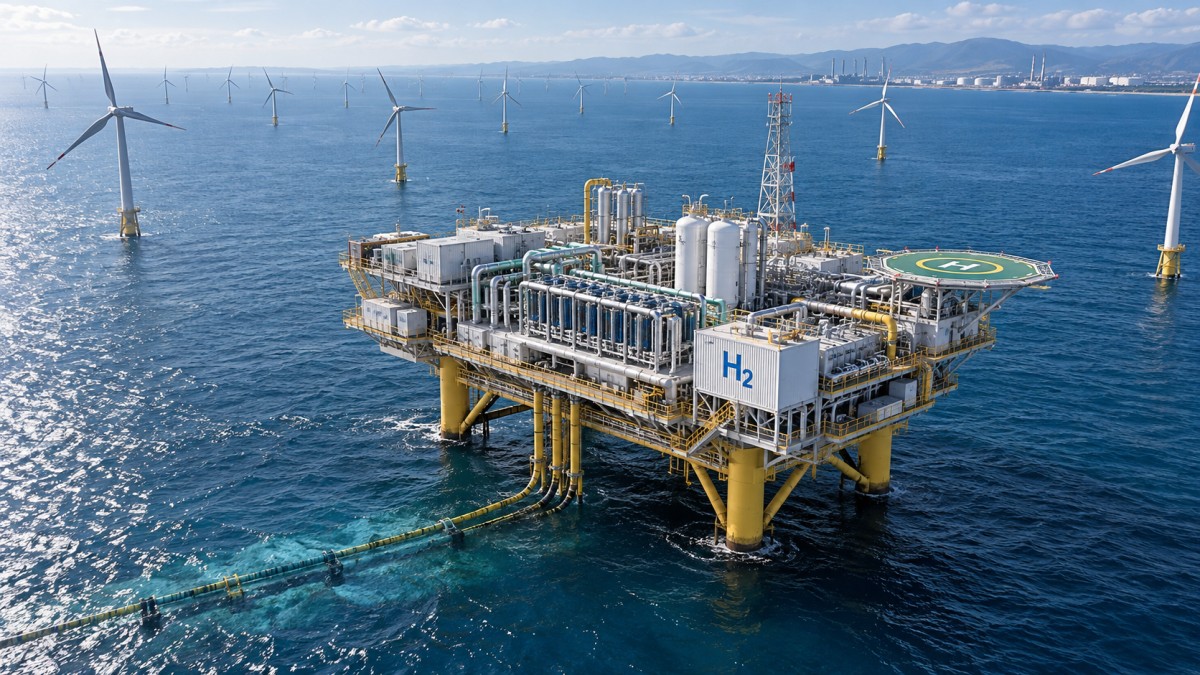
In the offshore hydrogen route, electricity is converted to hydrogen at sea. Electrolyzers may be located on a central platform or distributed across turbine installations. Hydrogen is then gathered, conditioned and transported to shore, generally by pipeline in the configurations considered here. The system may still need electrical cables for collection, controls, backup power or part of the wind farm’s output.
Comparing the cost of a hydrogen pipeline with that of an export cable is therefore insufficient. If the intended product is hydrogen at an industrial site, both routes should be assessed as delivered hydrogen. If the alternative is selling electricity, the analysis must compare the value and cost of two different products, including their respective market and contractual risks.
A practical comparison can be expressed as the present value of all project costs divided by the discounted quantity of hydrogen delivered over the same operating period. The boundary should include offshore generation, transmission, electrolysis, hydrogen conditioning and delivery. Residual values, decommissioning and financing assumptions should be treated consistently. This is a project-level measure, not a universal price for offshore hydrogen.
Where offshore conversion can save money
The strongest economic case arises when producing hydrogen at sea avoids a substantial part of the electrical export system. A long route to shore, a costly landfall or limited onshore grid capacity can make electrical export expensive. If a hydrogen pipeline can carry the planned output to a suitable landing point, its cost may compare favorably with the cables, substations and grid works it displaces.
Distance alone does not establish a winner. Pipeline and cable costs depend on route conditions, seabed preparation, crossings, water depth, installation methods and the availability of vessels. Electrical transmission design also changes with capacity and distance; alternatives may involve different current technologies, converter equipment and losses. The relevant question is the cost of the complete engineered connection, not a generic cost per kilometer.
Pipeline capacity and utilization matter as well. A line sized for future expansion can impose a large initial cost on a smaller first phase. Conversely, a shared hydrogen corridor may spread costs across several projects if capacity, timing, access rights and commercial terms are aligned. A proposed shared line should not be treated as available infrastructure until its funding, route and delivery schedule are sufficiently secure.
Existing offshore pipelines can appear attractive, but reuse is not equivalent to receiving a free asset. Suitability depends on the pipeline’s condition, design pressure, materials, remaining life, interfaces and intended hydrogen service. Inspection, modification, testing, compression and shore connection costs must be included, together with the risk that the asset cannot be made available on the required schedule.
What the offshore route adds
Moving electrolysis offshore introduces equipment and activities that an onshore site would not require in the same form. Depending on the design, these can include a platform or modified turbine structure, foundations, power conversion, desalination and water treatment, hydrogen drying, compression, safety systems, accommodation provisions and marine access arrangements.
Centralizing equipment on a platform can simplify some gathering and maintenance tasks, but adds a large offshore installation and electrical collection interfaces. Distributing electrolyzers across turbines can reduce the need to collect all power at a central conversion point, but multiplies equipment locations, hydrogen connections and maintenance interfaces. Neither configuration removes the need to assess the whole wind farm as a connected system.
Offshore facilities must also manage hydrogen leaks, ventilation, hazardous areas, emergency shutdown and separation from other equipment. These requirements affect layout, weight, inspection and access. They should be incorporated into the early design rather than treated as a small allowance added after equipment selection.
Water supply illustrates why a single equipment price is misleading. Electrolysis consumes purified water, and an offshore plant must provide a dependable treatment system and manage its associated utilities and discharges. Water itself is not necessarily the dominant cost, but the treatment package adds equipment, power demand, maintenance and interfaces in a location where space and access have value.
Some offshore designs also require a reliable auxiliary electricity supply when wind output is low or equipment is restarting. The source and cost of that supply, including any cable, generation or storage capacity, belong in the comparison. Assuming that a hydrogen-exporting wind farm needs no electrical connection can understate its cost and operating constraints.
Utilization can change the result more than equipment price
Electrolyzers supplied directly by wind do not run at full output continuously. Their annual hydrogen production depends on the wind resource, the ratio of wind capacity to electrolyzer capacity, minimum operating limits, conversion efficiency, outages and the plant’s control strategy. A larger electrolyzer can capture more power during high-wind periods, but may sit partly idle for longer. A smaller unit can achieve higher utilization while leaving more wind output unused or requiring another export route.
This sizing decision affects both alternatives, but their flexibility can differ. An onshore electrolyzer connected to the grid may be able to supplement wind generation with other electricity, subject to connection capacity, power prices, contracts and applicable requirements for claiming renewable hydrogen. It may also curtail production when electricity has a higher value elsewhere. An offshore unit without an equivalent electrical connection has fewer options to change its power supply or sell surplus output.
That flexibility is not free. Grid electricity may be expensive, and network charges or connection limits can materially affect the onshore case. Nor should all grid-supplied production automatically be assumed to qualify for a particular renewable-hydrogen claim. Eligibility depends on the rules and contractual evidence applicable to the intended market.
A sound model should use hourly or similarly resolved generation and operating profiles, rather than multiplying electrolyzer capacity by a single annual utilization assumption. It should calculate hydrogen delivered after conversion, conditioning and transport losses, and include the electricity needed for compression and auxiliary systems. Otherwise, a scheme that looks cheaper per installed megawatt can prove more expensive per kilogram delivered.
Reliability and financing deserve explicit costs
Maintenance at sea is not simply an onshore service budget plus a vessel allowance. Weather limits, travel time, spare-parts logistics and access to individual installations can extend repairs. A component failure that would cause a short interruption onshore may result in a longer outage offshore if a suitable crew or vessel cannot reach the site promptly.
The impact depends on system design. Redundant equipment, modular electrolyzers, spare compression capacity and accessible layouts can reduce lost production, but they increase capital expenditure. The comparison should show both the cost of redundancy and the expected production lost when equipment is unavailable, rather than assuming the same uptime for offshore and onshore plants.
Large component replacement is another important boundary. Electrolyzer stacks have finite service lives, influenced by technology and operating conditions. Replacing stacks offshore can involve lifting, transport, access and production downtime beyond the cost of the replacement equipment. The timing of those costs matters because a later expense has a different present value from an initial investment.
Financing can widen a modest engineering-cost difference. Lenders and investors assess construction interfaces, completion risk, operating history, insurance, contracts and exposure to technology performance. If an offshore configuration is judged riskier, a higher required return or more conservative debt terms can increase the cost of delivered hydrogen. The appropriate financing assumptions should reflect the project’s evidence and contracts, not an automatic penalty applied to every offshore design.
Delivery location and market value can reverse the comparison
A hydrogen plant at the coast is not necessarily close to the customer. Industrial demand may lie inland, requiring additional pipeline capacity, compression or another transport arrangement. Both options must include delivery from their respective landing or production points to the same customer gate, at the required pressure and quality.
Storage also needs a consistent treatment. Wind-driven production varies, while an industrial buyer may require a steadier supply. Offshore and onshore schemes can each need storage, backup supply or contractual flexibility, but the location and cost may differ. A model that compares intermittent offshore production with firm onshore delivery is not comparing equivalent services.
For a wind developer, the alternative to making hydrogen may be selling electricity rather than building an onshore electrolyzer. In that case, the decision is not settled by comparing hydrogen production costs. Expected electricity revenue, hydrogen offtake price, curtailment, grid charges and the allocation of risk under each contract determine which route creates more value. A low modeled hydrogen cost does not guarantee a viable project without a buyer prepared to accept its delivery profile and terms.
Finding the break-even point
The offshore route becomes cheaper on a delivered-hydrogen basis when the electrical export and onshore costs it avoids exceed its additional offshore conversion, hydrogen transport, operating and financing costs. That threshold is specific to the project. It cannot be reduced to a universal distance from shore because capacity, route, grid access and pipeline options change the balance.
A useful way to test the threshold is to compare two designs with the same wind resource, project life, delivery point and hydrogen specification. Start with independently engineered cable and pipeline routes. Include landfall and onshore connection works, then size each electrolyzer against the same wind profile. Add conditioning, compression, storage, maintenance, replacement, decommissioning and financing on consistent terms.
Sensitivity analysis should vary the assumptions most capable of changing the choice: connection cost, pipeline utilization, electrolyzer output, offshore downtime, stack replacement, power prices and financing terms. These variables should also be tested in combinations. A late pipeline, for example, can reduce early production and increase financing costs at the same time; treating those effects as unrelated can understate exposure.
If the offshore option wins only when cable costs are high, pipeline costs are low and offshore availability matches an onshore plant, the result is fragile. If it remains competitive across a reasonable range and the pipeline and offtake arrangements have credible delivery paths, the case is stronger. Equally, a well-connected onshore site may remain the lower-cost choice even for a distant wind farm when offshore maintenance and hydrogen infrastructure are fully priced.
The decisive question is not whether hydrogen or electricity is inherently cheaper to transport. It is whether changing the conversion location removes enough electrical infrastructure cost to pay for a more complex offshore plant and a complete hydrogen delivery system. The answer emerges from the project’s engineered routes, operating profile and contracts—not from distance or equipment prices alone.
- Last One:No more articles
- Next Article:Is Offshore Hydrogen Production Feasible Without a Grid Connection?2026-11-12
Tag
Recommended for You
{item.title}
News Categories
Leave Us a Message