
Trade and Delivery
Who Is Liable for Damage From Factory Handover to Offshore Delivery?
Who Is Liable for Damage From Factory Handover to Offshore Delivery?
Who is responsible for damage between factory handover and offshore delivery? The answer depends on when risk transfers under the contract, the agreed delivery terms, and the circumstances of the loss. For offshore energy projects, damage can occur during loading, inland transport, port storage, or the voyage offshore, with different parties involved at each stage. Contractual responsibilities, insurance, inspections, and handover records can help teams identify potential liability and manage gaps in coverage.
The distinction is especially consequential for subsea cables, foundations, turbines, electrical equipment, and fabricated modules. A component may leave a factory in acceptable condition but pass through several yards, lifting operations, and vessels before it reaches the installation site. By the time damage is discovered, the immediate question is often not simply who touched it last, but what the evidence can establish about when and how the damage occurred.
Risk transfer is not the same as fault
The party bearing the risk of loss at a particular moment may have to deal with the immediate financial consequences, even if another party caused the damage. That party may then seek recovery from a carrier, terminal operator, supplier, or other contractor, subject to the relevant contracts and applicable law.
Ownership, custody, risk, and insurance should therefore be considered separately. A buyer might own equipment before it leaves the supplier’s premises, while the supplier retains certain transport obligations. A carrier may have physical custody without accepting unlimited liability. An insurer may pay an eligible claim without determining the final allocation of fault between the project parties.
The supplier’s warranty also matters. Damage discovered after risk transfer could result from a manufacturing defect, inadequate preservation instructions, or a transport incident. The transfer of transit risk does not automatically resolve a claim for defective workmanship or breach of another contractual obligation.
Read the delivery term alongside the rest of the contract
Incoterms rules can establish important delivery and risk-transfer points when incorporated into a sale contract. They do not, by themselves, settle every question about title, product defects, remedies, delay, or liability to third parties. The contract should identify the chosen rule, edition, and named place precisely, then reconcile them with the project’s other agreements.
For example, under Incoterms 2020, FCA delivery at the seller’s premises occurs when the goods are loaded on the buyer’s collecting vehicle. If another named place is used, delivery generally occurs when the goods are placed at the carrier’s disposal on the arriving vehicle, ready for unloading. Those differences matter when a heavy lift is the operation most likely to damage the equipment.
Under DAP, delivery occurs when the goods are placed at the buyer’s disposal on the arriving means of transport, ready for unloading at the named destination. Unloading is therefore a separate interface to address. Under DPU, delivery includes unloading at the named place. A named destination should be specific enough to distinguish, for instance, a port gate from a laydown area or vessel berth.
Transport cost and risk transfer are not always aligned. Under CIP, the seller arranges carriage and insurance to the named destination, but risk transfers when the goods are delivered to the carrier in accordance with the rule. Project teams should check the insurance terms rather than assume that paying for freight means the seller bears transit risk throughout.
Offshore delivery adds another complication: a sale term may describe delivery to a port, while the commercial expectation is that the component will ultimately be on an installation vessel or at an offshore site. The contract must say who arranges and bears the risk of the remaining operations. A vague reference to “delivery offshore” can leave the most expensive interfaces unresolved.
Where damage and responsibility can change hands
A useful starting point is to map the physical journey, not just the commercial milestone. Each transfer should identify the party in control, the required handling method, the condition record, and the agreement governing that movement.
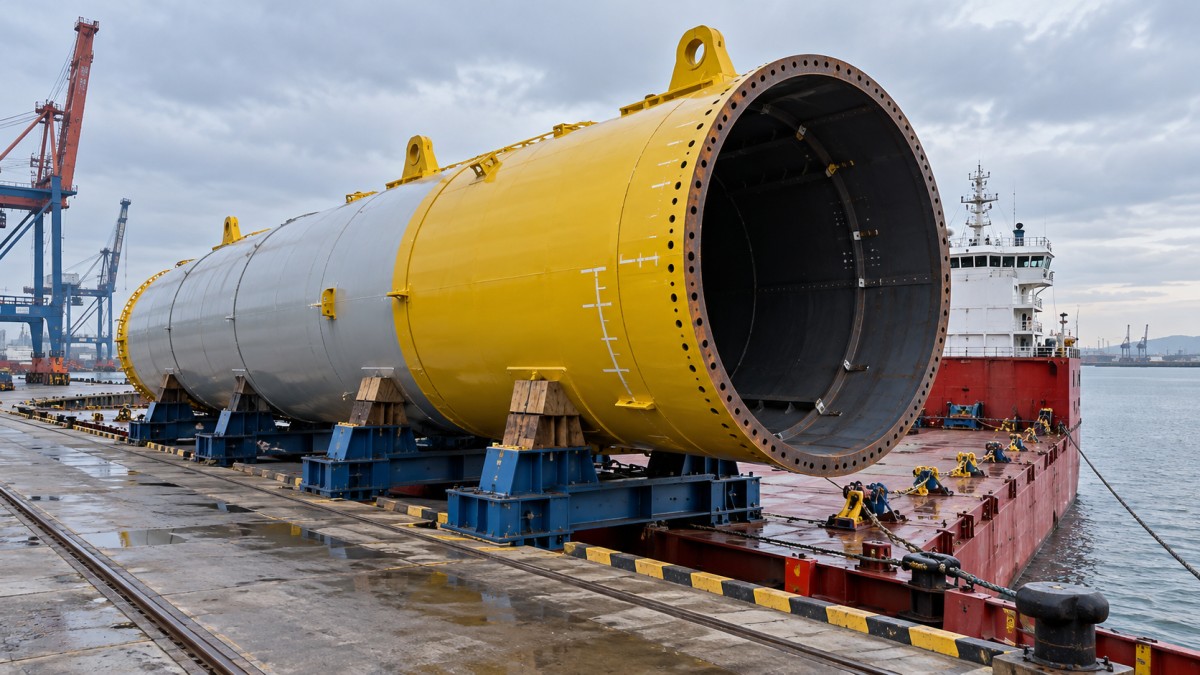
Factory release and loading
A factory acceptance test can establish that equipment met specified criteria at a given time. It does not necessarily establish that packaging, lifting points, restraints, or weather protection are suitable for every subsequent movement. The release record should distinguish test completion from physical handover and state whether loading is included in the supplier’s scope.
A foundation section, for example, may require engineered lifting arrangements and contact-point protection. If a contractor uses an unapproved lift plan, responsibility may differ from a situation in which the supplier provided incorrect lifting information. The purchase contract, lift plan, and handling instructions need to work together.
Road transport and port storage
Inland movement introduces route restrictions, load securing, vibration, and exposure to weather. At the port, the risk may change from a moving cargo to an item in temporary storage. Check whether the carrier’s service ends at the gate, on arrival at a berth, or after unloading into a designated area. Likewise, confirm who accepts the cargo and what the terminal’s receipt actually records.
Storage conditions deserve as much attention as the lift itself. Electrical equipment may need moisture control and periodic inspection; coated steel may require suitable supports and protection against contact damage. If a vessel is delayed, an intended short stay can become prolonged storage. Insurance and preservation obligations should contemplate that possibility rather than assume an uninterrupted journey.
Loadout, sea fastening, and the offshore voyage
At loadout, terminal personnel, a crane contractor, the vessel operator, and the cargo owner may all have a role. Responsibility for preparing the lift plan, approving sea fastenings, executing the work, and inspecting the result should be explicit. Approval by one party should not be casually treated as a substitute for the executing contractor’s obligations; the effect depends on the contract.
During the voyage, the relevant evidence may include fastening inspections, voyage records, weather information, and any report of cargo movement. The applicable vessel contract and any mandatory legal regime can affect recoverability, including notice periods and limits of liability. A cargo owner should not assume that the vessel’s insurance will reimburse the full replacement cost or the project’s delay losses.
Insurance can fund a loss, but it does not erase the interfaces
Marine cargo insurance or a project construction policy may cover physical loss or damage during some or all of the journey. The answer lies in the policy wording: insured property, covered parties, geographical limits, attachment and termination points, deductibles, exclusions, and conditions all matter. A certificate alone may not provide enough detail to assess a gap.
Pay particular attention to intermediate storage, loading and unloading, offshore transshipment, installation activities, and delays beyond the planned transit period. A policy described as “warehouse to warehouse” should still be checked against the actual warehouse locations and operations. Offshore installation is not automatically covered merely because the voyage is covered.
Physical damage cover is also different from cover for lost revenue or delay. Replacement manufacture, a missed vessel slot, remobilization, and a lost weather window can produce costs far greater than the repair itself, but recovery depends on the policies and contracts in place. Deductibles and any uninsured portion need an agreed allocation.
Where several parties are insured under a project policy, review the treatment of additional insureds, waivers of subrogation, and claims cooperation. These provisions can affect whether an insurer may pursue another project participant after payment. They should be coordinated with indemnities, liability caps, and knock-for-knock arrangements rather than negotiated in isolation.
The condition record often determines the quality of the claim
A signed receipt stating “received in good order” may be useful for visible condition, but it is not proof that concealed damage or internal defects are absent. Teams should record what was actually inspected, any limitations on access, and whether protective packaging remained intact. If damage is suspected, note it on the relevant receipt where practicable and follow the contract’s notice requirements.
For a cable delivery, the record might include drum identification, visible drum and flange condition, end-cap integrity, handling events, and the tests required by the project specification. For a large fabricated component, photographs of lifting points, coating, supports, and sea fastenings may be more useful. The inspection plan should follow the equipment’s failure modes, not a generic checklist.
When damage is found, preserve the component and packaging where safe, notify the relevant parties and insurers promptly, and arrange a joint survey if appropriate. Document the location and condition before repair or disposal. Emergency action may be necessary to prevent further loss, but it should be recorded so that later reviewers can distinguish the original damage from mitigation work.
Notice deadlines, evidence-preservation duties, and limitation periods vary by contract and applicable law. Missing one can weaken a recovery even where the technical cause seems clear. Legal and insurance advisers should be involved early, especially when several jurisdictions or transport modes are involved.
Close the gaps before the equipment leaves the factory
The most useful procurement exercise is a joint review of the purchase order, logistics contracts, vessel agreement, insurance wording, and installation scope against the actual route. For every handover, ask who performs the operation, who bears risk at that moment, what evidence will be created, and which policy is expected to respond. If different documents give different answers, resolve the conflict before mobilization.
That systems view is central to the planned OffshoreWire coverage of offshore project delivery: equipment specifications, vessel availability, port capacity, weather exposure, and commercial terms all affect whether a component reaches site ready to install. Before signing, teams should test their allocation against an unplanned storage extension, a damaged lift point, and a loss discovered only after offshore arrival. If the documents do not produce a clear next step for each scenario, the handover plan needs more work.
- Last One:No more articles
- Next Article:Reducing port congestion in offshore logistics2026-11-12
Tag
Recommended for You
{item.title}
News Categories
Leave Us a Message