Oil and Gas Retrofits
Can Existing Offshore Infrastructure Be Reused for a Wind Connection?
Yes. An existing offshore platform, export cable, landfall, or grid connection can sometimes form part of an offshore wind connection. Reuse is credible when the asset has enough verified capacity and remaining life, its owner can grant the necessary access, and the modified system can meet current electrical, structural, safety, and permitting requirements. A sound asset in the wrong location or with an unsuitable grid interface may still offer little value.
The decision is rarely a choice between reusing everything and building everything new. A project might retain a platform jacket but replace the topside equipment, or use an existing landfall while installing a new export cable. Each retained element creates interfaces with new equipment and obligations for inspection, maintenance, and eventual decommissioning. Those interfaces need to be compared with the scope, schedule, and risk of a new connection.
Which parts of an existing connection have value?
The answer starts with the intended power flow. A wind farm needs a route from its collection system to a suitable onshore connection point. Existing infrastructure is valuable only if it fits that route and can be adapted to the required electrical duty. A platform originally built to distribute power to offshore equipment, for example, was not necessarily designed to collect and export variable generation.
An existing route is not automatically an available route. A cable corridor may be congested, a platform may remain tied to an operating facility, and a former connection agreement may not transfer to a wind project. The initial screening therefore needs both engineering records and a clear account of ownership, access, and contractual restrictions.
A platform's remaining life is a design question
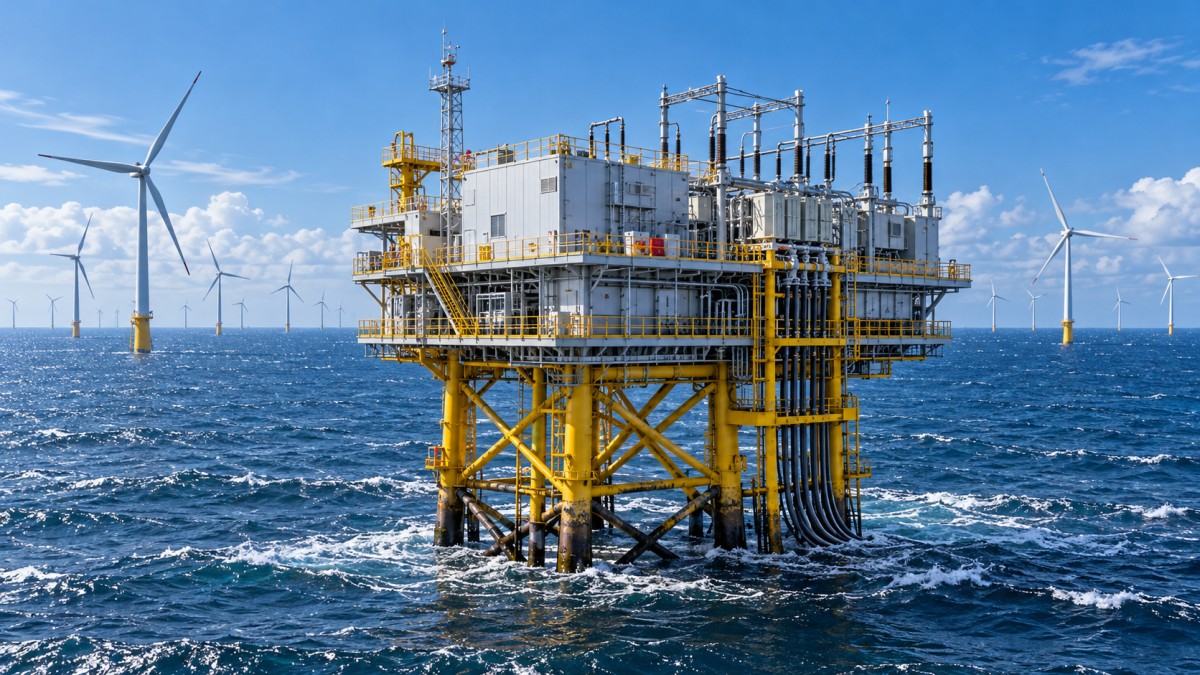
Reusing a platform requires more than confirming that it is standing and in service. The proposed electrical equipment changes the loads acting on the structure. Transformers, switchgear, cable hang-offs, temporary lifting equipment, and reinforcement add weight; their positions also affect the load path. The assessment must include transport and installation loads as well as the final operating arrangement.
As-built drawings provide a starting point, but the current condition has to be established through records and inspection. Corrosion, fatigue, previous repairs, accidental damage, marine growth, and foundation condition can alter the capacity assumed in the original design. A review of fatigue history is particularly important where the new service would extend operation well beyond the period for which the structure was originally assessed.
The useful remaining life of the whole connection is constrained by components that cannot readily be replaced or repaired. A jacket might be suitable for continued service while an inaccessible cable support, degraded conductor, or aging foundation detail introduces a different limitation. Conversely, a limited-life asset could be useful for a defined interim connection if the project has an agreed replacement strategy and the necessary approvals.
There is also a difference between a platform that can carry equipment and one that can safely accommodate the work needed to install and maintain it. Lifting clearances, escape routes, fire and explosion hazards, simultaneous operations, and access in poor weather can all affect the design. Where oil and gas systems remain active, physical and operational separation between those systems and new electrical equipment requires particular attention.
Existing cables: a rating is only the starting point
A cable's voltage and nominal current rating do not establish whether it can export power from a wind farm. The assessment must consider the complete circuit, including joints, terminations, switchgear, earthing, and protection. Voltage class and insulation must suit the proposed system, while conductor temperature must remain acceptable under the expected loading profile and installation conditions.
Burial depth, seabed thermal properties, crossings, and proximity to other cables affect heat dissipation. An original rating based on one set of assumptions may not apply after the route is modified or a new cable is installed alongside it. A cable that is electrically adequate at a terminal can still be constrained by a short section where heat cannot escape effectively.
Condition evidence is equally important. Installation records, repair history, fault logs, sheath test results, and route surveys help establish whether a cable has suffered damage or movement. Testing can reduce uncertainty, but a satisfactory test does not prove that every future fault has been ruled out. The assessment also needs to consider whether a spare length, compatible jointing system, and suitable repair vessel would be available if the cable failed.
Terminations deserve early attention because a cable designed for its original equipment may require a new interface at one or both ends. Removing an old termination, exposing sufficient cable, and installing a compatible joint or termination can be difficult where there is little slack or access. Any cutting and jointing plan must account for the cable's condition and the space available for the work.
Alternating-current and direct-current systems are not interchangeable simply because a cable follows a useful route. The proposed transmission configuration, insulation system, conversion equipment, and protection philosophy must be assessed together. Likewise, a cable originally used to supply an offshore facility does not automatically suit power flow in the opposite direction: the connected equipment and protection settings must support the proposed operating modes.
The grid connection may be the limiting asset
A connection point that once supplied an offshore facility does not necessarily have permission or capacity to receive wind generation. Import and export have different network effects, and the available capacity can change with other connections, network reinforcement, and the operating state of the grid. The relevant network operator must assess the proposed export arrangement; an inherited physical connection alone is not proof of an available export entitlement.
The electrical study should cover normal operation and credible faults across the whole system. Fault levels, voltage control, reactive power, harmonics, protection coordination, and communications can determine whether existing transformers and switchgear remain usable. Generation may also be curtailed under the terms of a connection agreement or particular network conditions. That affects the commercial value of reuse even when the equipment is technically capable of carrying the intended output.
Shared facilities create another constraint. If an existing installation still needs a reliable power supply, the wind connection must define what happens during maintenance, faults, and loss of generation. A design that works when every circuit is available may fail the required operating arrangement when one transformer, cable, or switchboard is out of service.
Comparing reuse with a new-build connection
A fair comparison starts with the same service requirement: export capacity, availability, operating life, grid connection point, and decommissioning boundary. Comparing the purchase price of new equipment with the apparent book value of an existing asset misses much of the decision. Reuse carries costs for surveys, engineering, modifications, testing, outages, and restoration after intrusive work. New construction carries its own route development, fabrication, installation, and commissioning scope.
The schedule comparison also needs a common basis. Existing infrastructure may shorten work where condition records are reliable, access is available, and modifications are limited. It can also introduce hold points: an inspection may reveal repairs that must be designed before detailed installation planning can proceed, or an operating facility may restrict the outage window needed for tie-in. A new-build option may take longer to develop but offer more control over layout and equipment interfaces.
Uncertainty should be visible in both options. For an existing cable with incomplete records, the estimate can distinguish the cost of continued use from the cost and schedule consequence of discovering damage or needing replacement. For a platform, it can separately identify inspection, strengthening, and access modifications. Treating uncertain work as a single contingency without describing its cause makes alternatives harder to compare and can obscure an unacceptable installation sequence.
Availability matters throughout operation, not just at commissioning. A reused export cable with limited repair options may be economical to acquire yet expose the project to a prolonged interruption after a fault. Equally, a new cable is not automatically preferable if its route presents difficult crossings or repair access. The relevant comparison is the expected service of the complete connection, including credible failure and recovery scenarios.
Permissions and ownership can change the answer
Reuse changes the purpose, loads, and operating arrangements of an asset. Existing permits or consents should not be assumed to cover those changes. The required process depends on the jurisdiction, asset, location, and scope of work; it can include review of marine activities, environmental effects, electrical safety, and changes to an approved decommissioning plan.
Environmental assessment should consider the work actually proposed. Retaining a structure may avoid some removal and new installation activities, but reinforcement, cable protection, seabed disturbance, vessel operations, and eventual removal can still have effects. A comparison with new construction needs a consistent project boundary and evidence about the condition of the existing site; reuse alone does not establish a lower impact.
Commercial rights are just as specific. The agreement for a retained asset needs to establish who owns it, who can enter and modify it, how outages are coordinated, and who pays for inspection, repair, and removal. Historic liabilities and the condition at transfer require explicit treatment. Shared infrastructure also needs a procedure for resolving conflicts between continued operation of the original facility and wind connection work.
When does reuse become a credible option?
The strongest candidate has a useful route, a viable export interface, accessible condition records, and enough demonstrated structural and electrical margin for the proposed duty. It also has a practical plan for the elements that will not last for the full project life. These conditions can justify progressing from an initial screen to detailed surveys and design.
Where records are incomplete, the next commitment should be linked to evidence that can change the decision. A targeted structural inspection, cable condition assessment, or network study may determine whether the project advances with reuse, retains only part of the asset, or returns to a new-build design. The point at which that evidence becomes available matters: discovering an unusable interface after equipment has been ordered can erase much of the apparent saving.
- Last One:No more articles
- Next Article:No more articles
Tag
Recommended for You
{item.title}
News Categories
Leave Us a Message